It is the question everyone thinks and nobody asks: where does it all go? The waste from portable toilets does not vanish, does not get dumped behind the depot, and does not go down some mysterious drain. It travels through one of the most regulated handling chains in the service industry — vacuum pumping, sealed transport by licensed haulers, and disposal at permitted treatment facilities, with documentation at every step.
This guide follows the full journey from tank to treatment. You will learn what is actually in the tank besides the obvious, which facilities are allowed to receive the waste, what environmental rules govern every step, and — most importantly for you — why waste handling is the supplier's job from start to finish, never yours. Understanding the chain also helps you vet suppliers: the ones who handle waste properly are the ones worth hiring.
From Tank to Treatment: The Full Journey
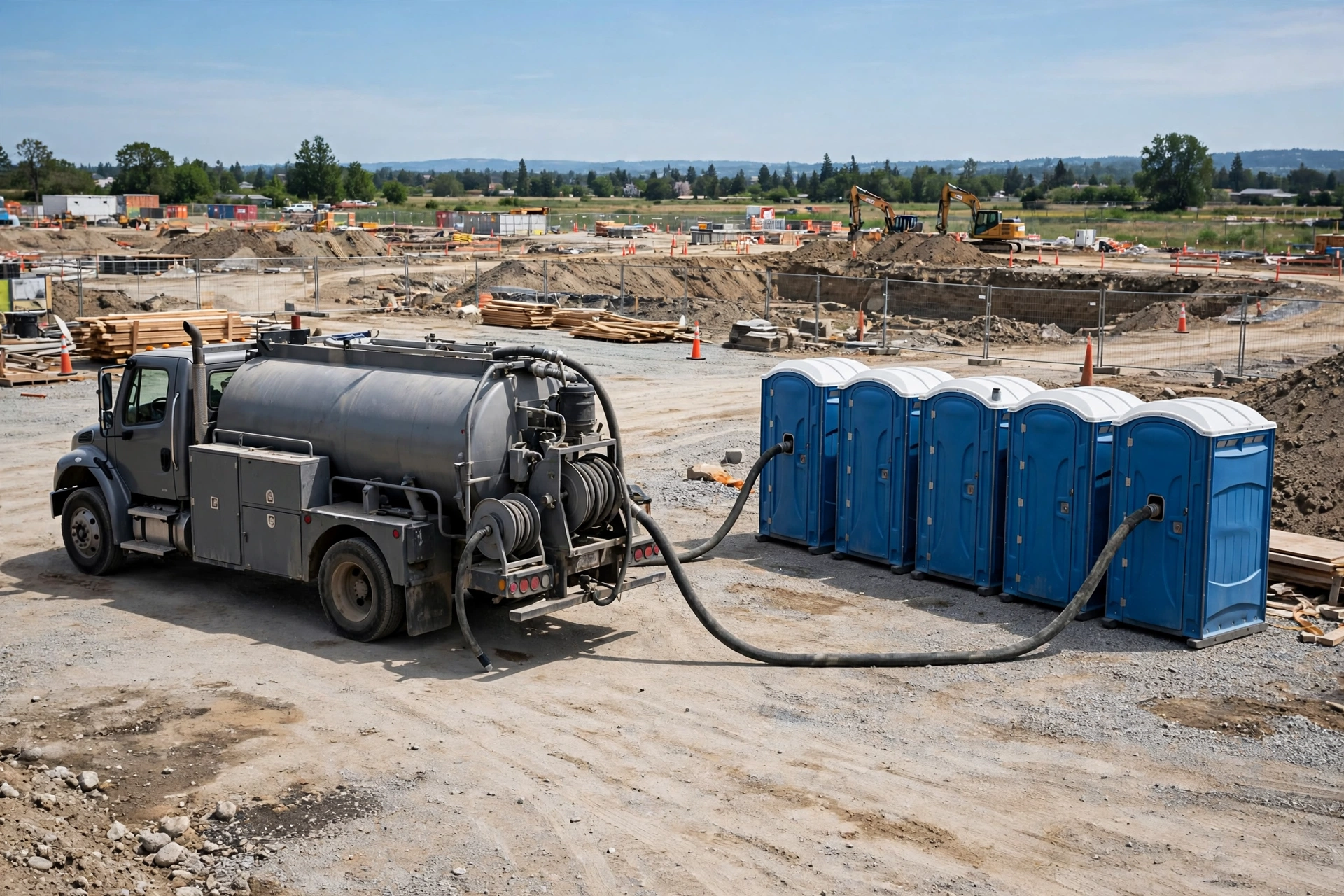
The journey starts at your site during a routine service visit. A vacuum pump truck pulls up, the technician connects a heavy suction hose to the unit's tank outlet, and the truck's vacuum system draws the entire tank contents — liquid waste, solids, paper, and deodorizing fluid — into the truck's sealed holding tank. The process takes a few minutes per unit and is fully contained: nothing touches the ground, nothing is exposed to the air beyond the immediate work area.
Once the tank is empty, the technician recharges it with fresh deodorizing fluid and water, wipes down the interior, restocks supplies, and moves to the next unit. The truck's holding tank, now carrying waste from the full route, stays sealed for the drive to the disposal facility. At the facility, the truck discharges into the receiving system through a closed connection — again, contained end to end. The truck is then cleaned and returns to route. That is the entire physical chain: tank to hose to truck to facility, sealed at every transfer.
Two things worth noting. First, the waste never sits. Routes are planned so trucks discharge at licensed facilities on schedule, not when convenient — haulers operate under permits that specify where they may discharge. Second, every step is performed by trained technicians with protective equipment and spill protocols. This is professional hazardous-material handling, scaled down to a service route. Our servicing guide describes what happens at your site during each visit.
What Is Actually in the Tank
Besides the obvious, a portable toilet tank contains the blue deodorizing fluid — and that fluid is doing more work than most people realize. Standard portable toilet chemistry generally combines several functions: biocides that suppress odor-causing bacterial activity, a dye (the familiar blue) that masks the contents visually, fragrance compounds, and surfactants that help break down solids and paper so the tank pumps cleanly. Winter formulations add freeze resistance for cold-weather service.
The chemistry matters for disposal because treatment facilities need to know what they are receiving. The fluids used by professional suppliers are formulated to be compatible with wastewater treatment — they break down in the treatment process rather than disrupting it. This is one more reason to hire established suppliers and not improvise: the wrong chemicals in the tank can cause real problems downstream, and some jurisdictions restrict specific compounds. Professional-grade deodorizer from a reputable supplier is part of the compliance chain, not just a nice smell.
What should never be in the tank: trash, construction debris, paint, solvents, or any hazardous material. Portable toilet tanks are for human waste, toilet paper, and approved deodorizing fluid — nothing else. Contaminated tanks create disposal problems and can trigger extra charges, because the receiving facility may reject or surcharge a load that does not match its permit. Keep foreign material out of the units and the chain runs clean.
Licensed Disposal: Where the Trucks Legally Go
Pump trucks cannot discharge just anywhere. They operate under hauler permits that name the facilities authorized to receive their loads. In practice, portable sanitation waste goes to one of a few types of destinations:
- Municipal wastewater treatment plants. Many treatment plants accept septage — the industry term for waste pumped from septic tanks and portable toilets — at designated receiving stations. The waste enters the same treatment process as ordinary sewage: screening, biological treatment, disinfection, and safe discharge or reuse of the treated water.
- Septage receiving facilities. Some regions have dedicated facilities built specifically to receive and pre-treat pumped waste before it moves into the main treatment stream. These exist because septage is more concentrated than ordinary sewage and benefits from dedicated handling.
- Permitted private treatment facilities. In some markets, licensed private operators run treatment or transfer facilities authorized to receive hauler loads under state permits.
What the destinations share: permits, oversight, and record-keeping. Receiving facilities log incoming loads — who delivered, how much, when — which creates a paper trail from your site's tank to final treatment. Legitimate haulers keep manifests of their own. That documentation is the backbone of the whole system: it proves the waste went where the law requires, and it is what separates professional operators from the ones you read about in enforcement headlines.
The Environmental Rules Governing Every Step
Portable sanitation waste is regulated at multiple levels, and the rules have teeth. At the federal level, the Clean Water Act framework governs what treatment plants may discharge, which sets the standards the whole upstream chain must meet. States layer on their own septage management rules: hauler licensing, vehicle standards, designated disposal sites, and record-keeping requirements. Local authorities add operating details like where trucks may discharge and during what hours.
The sharp edge of the law is illegal dumping. Discharging portable toilet waste anywhere other than a permitted facility — into a storm drain, onto land, into a waterway — is an environmental violation carrying serious civil and criminal penalties. Enforcement agencies pursue it aggressively because the public-health consequences are real: untreated waste contaminates groundwater, spreads disease, and devastates waterways. This is not a theoretical risk. Operators caught dumping illegally face fines, permit revocation, and prosecution.
For you as the customer, the practical takeaway is vetting. Ask your supplier where waste goes and whether their haulers are licensed — it is question six on our 15-question checklist. A legitimate company answers immediately and specifically. Evasion on waste disposal is one of the brightest red flags in the business, because proper disposal costs money and the companies skipping it are cutting the corner that matters most.
What Happens at the Treatment Plant
Once the truck discharges at a receiving station, the waste joins the treatment stream. The general process at a municipal plant runs in stages. Screening and grit removal take out rags, plastics, and inorganic material — which is another reason foreign trash in portable toilet tanks causes problems. Primary treatment settles out solids. Secondary biological treatment uses microorganisms to break down organic matter — the same biological processes, scaled up enormously, that the deodorizing fluid was merely suppressing in the tank.
Disinfection — typically chlorine or ultraviolet treatment — neutralizes pathogens before the treated water is discharged to a waterway or reclaimed for reuse. The separated solids become sludge, which is further treated, and in many plants processed into biosolids for regulated land application. Nothing about this is casual: treatment plants operate under discharge permits with strict limits, continuous monitoring, and regular inspection. Your portable toilet waste ends its journey as treated water and managed solids, through infrastructure built for exactly this purpose.
Why You Never Handle Any of This Yourself
Here is the part that matters most to you directly: waste handling is the supplier's job, in full, under every reputable rental arrangement. You do not pump tanks. You do not transport waste. You do not arrange disposal. You do not touch the inside of a tank, ever. Every rental includes scheduled servicing by trained technicians with the right equipment, protective gear, permits, and disposal arrangements. That is a core part of what the rental pays for.
The reasons are health, legal, and practical. Health: human waste carries pathogens, and handling it without training and protective equipment is genuinely dangerous. Legal: transporting and disposing of septage requires hauler licensing and permitted discharge points — a customer improvising disposal is breaking the law whether they know it or not. Practical: you have neither the vacuum equipment nor the facility relationships, and acquiring them for a temporary need is absurd. If a unit has a problem — a leak, a tip-over, a blockage — you call the supplier. That is the entire procedure.
This is also why the cheapest quote is not always the real quote. Proper waste disposal has real costs: licensed hauling, discharge fees at receiving facilities, trained labor, compliant equipment. A bid that seems impossibly low may be cutting exactly here — and a supplier cutting disposal corners is a liability attached to your site. When you compare suppliers, the waste chain is part of what you are evaluating, whether the quote mentions it or not.
What Responsible Companies Do Differently
Since you cannot watch every pump-out, know the markers of a supplier that handles waste right. Responsible companies service on a real schedule — because tanks pumped on time do not overflow, and overflows are how waste escapes containment. They use professional-grade deodorizing chemistry compatible with treatment plants. Their technicians carry spill kits and actually know the spill protocol. Their trucks are maintained, permitted, and discharge only at licensed facilities.
They also keep records. Service logs showing when each unit was pumped, manifests from disposal facilities, hauler licenses current and available — documentation is the difference between a company that handles waste properly and one that says it does. Ask to see it when the stakes are high: large events, long-term contracts, municipal work. The good companies produce it without blinking.
Finally, responsible companies train for the bad day. Tip-overs, leaks, and spills happen in this business — wind, crowds, and construction sites see to that. What separates the pros is response: containment first, cleanup immediately, reporting as required, and a straight account to the customer. Ask about the spill and incident protocol before you book. It is question seven on the checklist, and the answer tells you everything about how seriously a company takes the waste chain.
Frequently Asked Questions
Where does portable toilet waste go after it is pumped?
To a licensed disposal facility — typically a municipal wastewater treatment plant's septage receiving station or a permitted septage facility. The waste enters the standard treatment process: screening, biological treatment, disinfection, and safe discharge or reuse. Haulers operate under permits that specify exactly where they may discharge.
What is the blue liquid in portable toilets?
Deodorizing fluid with several jobs: biocides that suppress odor-causing bacteria, blue dye that masks contents visually, fragrance, and surfactants that help solids and paper break down for clean pumping. Professional-grade fluid is formulated to be compatible with wastewater treatment. Winter versions add freeze resistance.
Is portable toilet waste bad for the environment?
Untreated, yes — which is exactly why the handling chain is regulated. Properly managed, the waste goes to treatment plants built to process it safely, ending as treated water and managed solids. The environmental risk comes from improper handling and illegal dumping, not from the rental itself.
Can I empty a portable toilet tank myself?
No — do not attempt it. Handling septage requires training, protective equipment, licensed hauling, and discharge at a permitted facility. Improvised disposal is illegal and dangerous. Tank servicing is included in every rental; if a unit needs attention between visits, call the supplier.
What happens if a portable toilet tips over or leaks?
Call the supplier immediately — that is the entire procedure for you. A responsible company responds with containment, cleanup, and reporting per its spill protocol, then rights or replaces the unit. Ask about the incident protocol before you book so you know the response is real.
How do I know my supplier disposes of waste legally?
Ask directly where waste goes and whether their haulers are licensed — legitimate companies answer immediately and specifically. Look for documented service schedules, disposal manifests, and current hauler licensing. Evasion on waste disposal is one of the brightest red flags in the business.
Ready When You Are
One call handles the whole thing: unit selection, delivery scheduling, servicing cadence, and pickup. Call (855) 343-0136 — lines are open Mon–Sat 7am–7pm CST, Sun 7am–12pm CST.
More Guides
- What Affects Porta Potty Rental Cost: 7 Pricing Factors Explained
- How Many Portable Toilets Do I Need? Sizing Guide, Tables & Calculator
- OSHA Portable Toilet Requirements for Construction Sites (2026 Guide)
- Do You Need a Permit for a Porta Potty? Rules by Placement Explained
- How Often Are Porta Potties Serviced? Schedules & What's Included