The Premium End of Portable Sanitation
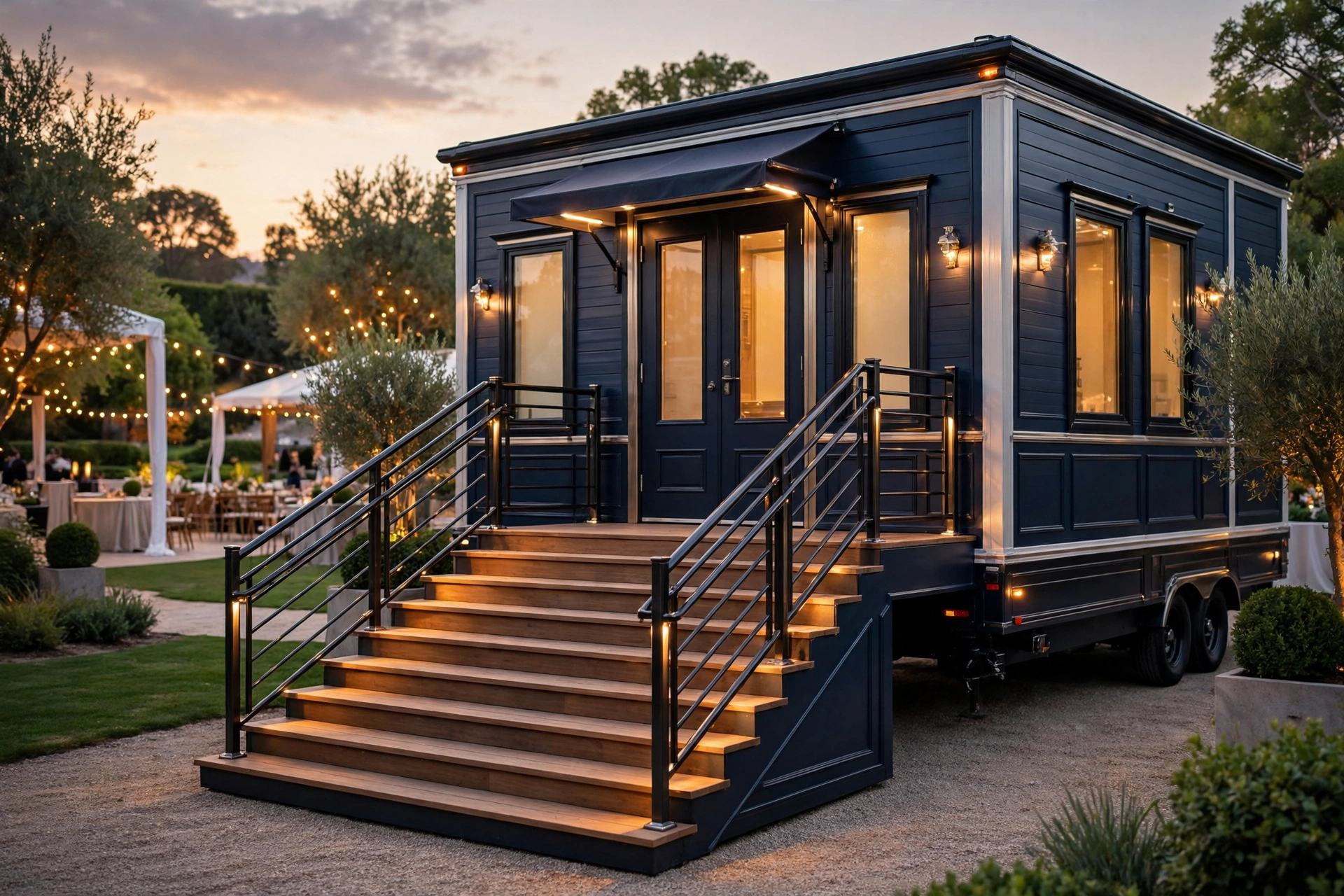
Some events need more than a portable toilet. They need a bathroom. Luxury restroom trailer rental is the top tier: two to ten private stations with flushing porcelain toilets behind locking doors, running-water sinks, vanity lighting, mirrors, solid-surface counters, and real climate control. Guests walk in expecting a compromise and walk out surprised. That reaction is the entire point.
Trailers are measured in stations — private toilet compartments. A 2-station trailer suits intimate gatherings up to about 100 guests and fits where bigger units cannot. The 3-to-5-station mid-range units are the workhorses: a 4-station trailer comfortably serves 200 to 250 guests at a typical reception. At the top, 8-to-10-station flagships handle 500-plus guests at festivals, galas, and large corporate events. Bigger is not automatically better — match the trailer to your headcount and your venue's reality, and we will sanity-check the fit when you call (855) 343-0136.
Inside, the women's side typically carries more stalls than the men's, reflecting real usage patterns, and larger trailers add urinals on the men's side to speed throughput. Climate control is standard: air conditioning for summer, heat for spring and fall. Many trailers play background music, which solves the awkward-silence problem elegantly. Freshwater and waste run on onboard tanks unless the venue offers a sewer cleanout for direct connection — effectively unlimited capacity for big multi-day events.
Who Rents Restroom Trailers
Couples hosting 125-plus-guest or black-tie weddings. Corporate planners running product launches, galas, and executive events. Festival organizers building VIP areas. Film and production crews on location. Municipalities hosting high-profile public events. Anyone whose guest list includes people who will judge the facilities — donors, executives, clients, or a mother-in-law with standards.
Trailers also earn their keep on multi-day productions and remote sites where the same group uses the facilities for days: crew bases, tournament headquarters, fair administration. Overnight pump-outs and restocking keep the trailer fresh across the whole run.
What Your Site Needs to Provide
Three things: level ground, power, and water. The footprint runs bigger than most people expect — plan on the trailer length plus tow-vehicle maneuvering room, roughly two parking spaces for a mid-size unit and more for the flagships. The ground must be firm and level; a trailer cannot be set safely on a slope or soft turf, and the delivery route needs clearance for truck and trailer.
Power: smaller trailers typically need one or two dedicated 20-amp circuits — standard household outlets. Larger units with full climate control may need 30 or 50 amps. Your venue's electrician or a rented generator covers it, but confirm during planning, not on event day. Water: a standard garden-hose connection at most venues, or the trailer runs from its onboard freshwater tank, which we fill before delivery, sized to your event.
Setup takes under an hour once positioned: leveling, power and water connections, and a full systems check before handover. We deliver several hours before guest arrival so setup never competes with your vendors for space and attention.
Attendant Service: The White-Glove Version
Add an attendant and the trailer stays pristine all event long. They restock paper and soap, wipe down counters and mirrors, empty trash, manage the climate control as the evening cools, keep the music playing, and handle any issue before a guest notices. For weddings, the trailer looks as good at the last dance as at cocktail hour. For corporate events, it matches the hospitality level of everything else you have invested in.
Attendants are also the practical choice past six hours, where consumables and tidiness need continuous attention rather than one mid-event visit. The attendant works from a discreet station near the entrance and coordinates timing with your planner. Ask about staffed dates when you reserve — attendants book alongside the trailers themselves.
Booking Lead Times
Trailers are the scarcest inventory in portable sanitation and they book on the wedding calendar. May through October, prime Saturdays go first. For a peak-season Saturday, reserve eight to twelve weeks ahead at minimum. Large multi-station trailers for festivals: lock them even earlier, since only a few exist in any region. Shoulder seasons and weekdays have more breathing room, but confirm availability rather than assuming it.
When you book, we lock the trailer size, delivery and pickup windows, power and water requirements, and attendant service in one confirmation. If your date flexes, say so — shifting a Friday event to Sunday can open inventory and simplify logistics considerably.
Straight Answers
How many guests can a restroom trailer serve?
A 2-station trailer suits up to about 100 guests, a 4-station unit handles 200 to 250 at a typical reception, and 8-to-10-station trailers serve 500 or more. Event length, alcohol, and whether usage comes in waves all affect the right size.
What utilities does a trailer need?
Level ground, power, and water. Smaller units run on one or two 20-amp circuits; larger ones may need 30 or 50 amps. Water comes from a hose hookup, or the trailer runs from its onboard freshwater tank.
How much space is needed?
Roughly two parking spaces for a mid-size trailer plus tow-vehicle maneuvering room; more for the big flagships. Ground must be firm and level, and the delivery route needs truck-and-trailer clearance.
What does the attendant do?
Stays with the trailer throughout the event: restocking, wiping down counters and mirrors, emptying trash, managing climate control, and handling issues before guests notice. The best upgrade for weddings, galas, and events past six hours.
Are trailers heated and air conditioned?
Yes — climate control is standard: AC for summer events, heat for spring and fall. The interior stays comfortable regardless of outdoor conditions.
Picking the Right Trailer Size
Trailer size is stations, headcount, and venue reality. The station counts below assume a typical four-to-six-hour event. Longer events, open bars, and crowds that arrive all at once push you one size up. When you are between sizes, the bigger trailer is almost always the right call — nobody ever complained about a restroom that was too nice.
- 2-station trailer: up to about 100 guests. Intimate weddings, executive events, tight sites where a big unit cannot fit.
- 3-station trailer: 100 to 150 guests. Small weddings, corporate gatherings, VIP areas at mid-size events.
- 4 to 5 stations: 200 to 300 guests. The workhorse range — most weddings and galas land here.
- 6 to 8 stations: 300 to 500 guests. Festivals, large galas, tournaments, and events with heavy peak waves.
- 10 stations: 500-plus guests. The flagship — big festivals, major corporate events, and multi-day productions.
Watch the wave pattern, not just the headcount. A 300-guest wedding spreads usage across the evening. A 300-person concert sends everyone at intermission. Same number, very different demand curve — the concert wants the bigger trailer. Tell us how your event actually flows and we will size past the raw math.
Venue reality can overrule the math. A 4-station trailer needs roughly two parking spaces plus maneuvering room, power, and water. If your site cannot provide those, a pair of deluxe units on plain level ground beats a trailer that cannot be set. We sanity-check every booking against the site before we confirm it.
Delivery Day: What Actually Happens
The trailer arrives several hours before guest arrival — never during your vendor rush. The driver positions it on the confirmed level spot, levels the unit, connects power and water, and runs a full systems check: every flush, every faucet, the climate control, the lights, the music. You walk it with the driver before sign-off. If anything is not right, it gets fixed on the spot, not after your guests arrive.
What we need from you: the spot confirmed and clear, power and water live before the truck rolls, maneuvering room kept open — no vendor trucks parked in the trailer lane — and a contact who can approve the final position. Setup takes under an hour once positioned. Pickup runs after the event on the agreed window: final pump-out, disconnect, and gone.
More Straight Answers
Can a trailer hook into a sewer line?
Yes, where the venue offers a cleanout or sewer connection — that gives the trailer effectively unlimited waste capacity for big multi-day events. Otherwise the onboard waste tank handles the full event, with pump-outs scheduled for multi-day runs.
What size generator do we need?
It depends on the trailer: smaller units run fine on a standard portable generator, larger climate-controlled units need more capacity. Tell us the trailer size and we will give you the exact power spec to hand your generator vendor — no guessing on event day.
Can a trailer run in winter?
Yes. Trailers carry heat as standard equipment, and the interior stays comfortable in cold weather. For hard freezes we winterize the water lines and manage the tanks so everything stays functional. Cold-season events book trailers all the time.
Do guests wait long at a 4-station trailer?
No — that is the point of the stations. Four private compartments with flushing toilets turn over far faster than four standard units, and the women's side carries extra stalls to balance real usage patterns. Lines at a properly sized trailer are rare and short.
Trailer Logistics Most People Forget
The trailer is the easy part. The logistics around it are where events get surprised. First: the tow vehicle needs somewhere to go. Once the trailer is set and leveled, the truck unhooks and leaves — or stays, if your site has nowhere for it to park. Confirm that during planning, because a dually with a gooseneck sitting in your vendor lane all day is a problem you do not want to discover at load-in.
Second: the route in is the route out. Overhead branches, soft shoulders, tight turns — the trailer needs the same clearance leaving as arriving, and event sites change over a weekend. Keep the trailer lane clear of vendor setups and parked cars for the whole run, or pickup turns into a negotiation with everyone who boxed it in. Third: designate one person who owns the trailer. Power trips, a faucet left running, the music cutting out — small stuff, but it needs one name attached so it gets handled in minutes instead of becoming a guest complaint.
None of this is hard. It is just the unglamorous checklist that separates a trailer that wows from a trailer that annoys. We walk through all of it on the booking call, and the driver confirms every item on delivery day before sign-off.
Related Services
- Construction Porta Potty Rental
- Event Porta Potty Rental
- Wedding Porta Potty Rental
- ADA Portable Toilet Rental
- Deluxe Flushable Porta Potty Rental
- Hand Wash Station Rental
Serving all 48 contiguous states and Washington DC — see all locations.