Renting portable toilets looks simple from the outside: you call, units show up, everybody is happy. The gap between that fantasy and reality is the supplier. A good company delivers clean units on time, services them without being asked, and answers the phone when something goes wrong. A bad one delivers late, services never, and ghosts you the moment there is a problem — and by the time you find out which one you hired, your event is underway or your crew is on site.
The fix is fifteen questions, asked before you book. They cover servicing, insurance, delivery reliability, fees, fleet condition, and what happens when things go sideways. A solid company answers every one of them directly and without defensiveness — they hear these questions daily from experienced buyers. A shaky company dodges, hedges, or rushes you off the phone. Listen for the difference. It will save you more grief than any other part of the planning process.
The 15 Questions
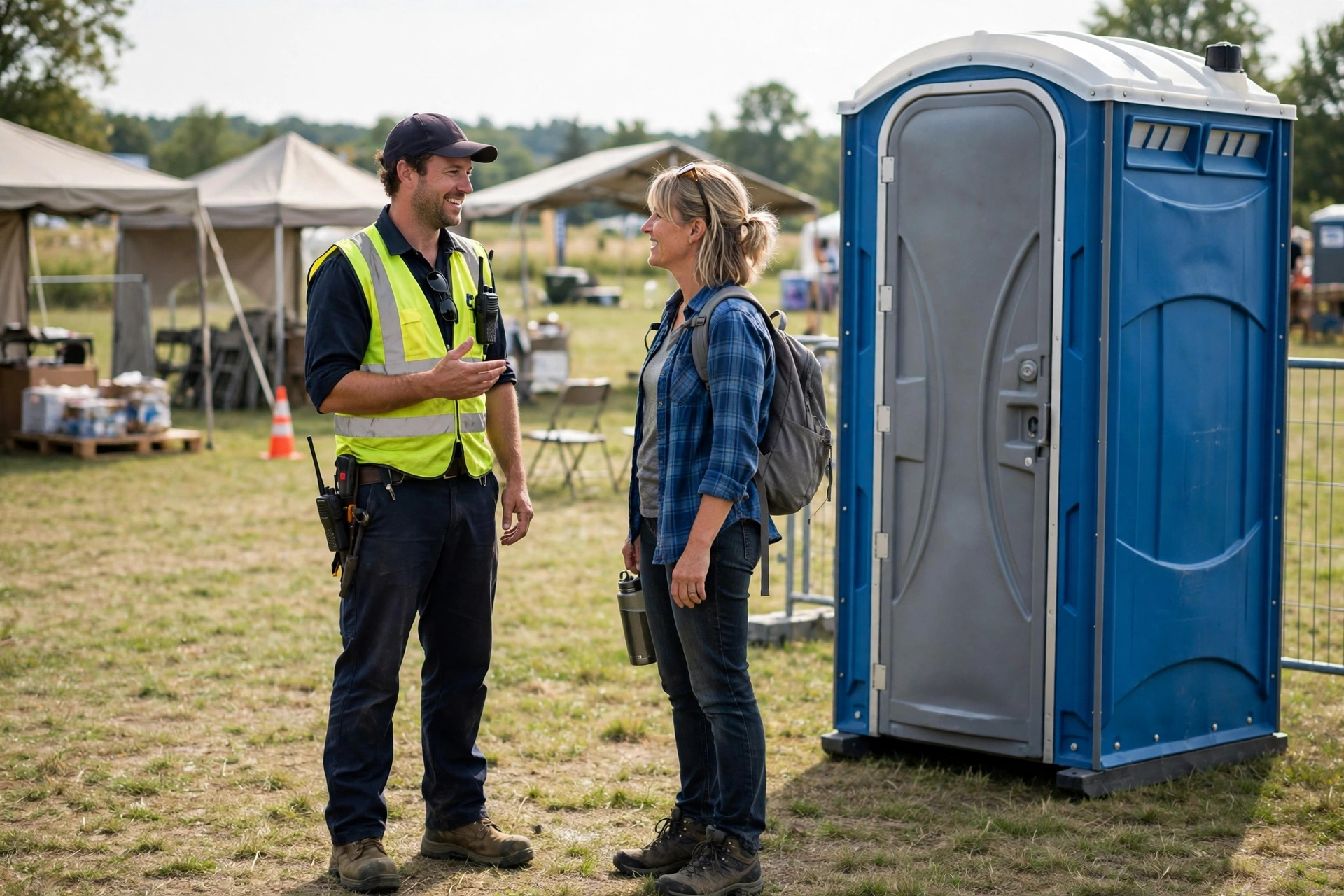
1. What exactly is included in the rental?
Start here, because inclusion varies more than people expect. A complete rental covers delivery to your site, professional setup and placement, scheduled servicing for the rental period, and final pickup. Some companies itemize delivery and pickup separately; some bundle everything. Neither approach is wrong, but you need to know which one you are looking at before you compare quotes. A good answer is specific: the supplier lists each included item without being asked. A bad answer is vague — if they cannot tell you what is included, they cannot tell you what is not, and the surprises come later.
2. How often will the units be serviced, and what does a service visit include?
This is the most important question on the list. Servicing is the difference between a rental that works and one that becomes a horror story. A proper service visit means pumping the holding tank, recharging deodorizer, wiping down interior surfaces, restocking toilet paper and hand sanitizer, and checking the unit's general condition. Ask what the standard cadence is for your situation — weekly is the baseline for construction, event-based for gatherings — and what triggers an extra visit. A good answer names the tasks and the schedule. A bad answer is some version of we will take care of it, with no specifics. Vague servicing promises are how units go unserviced for weeks.
3. What is the delivery window, and do you guarantee it?
Sometime Tuesday is not a delivery window; it is a hope. Ask for the actual window — morning or afternoon on a specific day — and ask what happens if they miss it. Good companies commit to windows and communicate proactively when routes shift. They will also tell you what they need from you to hit the window: site ready, placement marked, access clear. If a supplier will not commit to a window at all, assume delivery happens whenever it is convenient for them, which may not be convenient for you. For events with vendor load-in schedules, a guaranteed window is not a luxury.
4. Are there any fees beyond the quoted rental amount?
Ask this in plain language and listen carefully. Common extras in the industry include delivery beyond a standard service radius, difficult-access placement, additional servicing visits beyond the included schedule, damage or excessive-cleaning charges, and charges for units that cannot be picked up on schedule because the site is not ready. None of these are scams — they are real costs — but they should be disclosed upfront, not discovered on the final invoice. A good answer walks through each potential extra before you ask twice. A bad answer is just no, trust us. Get the fee structure in writing with the quote.
5. What condition will the units be in when they arrive, and how old is the fleet?
Portable toilets live hard lives, and fleet age shows. Ask how old the units are and what the cleaning standard is between rentals. You are listening for specifics: units pressure-washed and disinfected between every rental, damaged units pulled from rotation, a replacement cycle for aging inventory. A company proud of its fleet will tell you about it. A company running twenty-year-old boxes held together with hope will change the subject. If possible, ask to see the units — or at minimum, ask what happens if a unit arrives in unacceptable condition. The answer should be immediate replacement, no argument.
6. Do you carry liability insurance?
Non-negotiable, especially for public events and commercial jobsites. The supplier's trucks are operating on your property, their equipment is being used by your guests or workers, and if something goes wrong — a unit tips in high wind, a delivery truck damages a surface — insurance is what stands between an incident and a lawsuit naming you. Ask for proof: a certificate of insurance, not a verbal assurance. Many venues and general contractors require it before the supplier is even allowed on site. A legitimate company produces it routinely. Hesitation here is a walk-away signal.
7. What happens if a unit is damaged, tipped over, or vandalized?
Things happen. Wind tips units. Festival crowds abuse them. A delivery truck is not the only thing that can go wrong on a site. Ask how damage is handled: who do you call, how fast is the response, is there a charge, and what counts as normal wear versus damage you pay for. A good answer includes a response-time commitment and a clear damage policy. You are really testing two things: whether they have a plan, and whether you can reach a human when you need one. The company with no damage plan is the company that argues about the invoice later.
8. How do you handle emergency service calls and extra visits?
Separate from damage: what if a unit fills up mid-event, runs out of paper during a festival, or needs attention between scheduled visits? Ask how to request an extra service call, how fast the response is, and whether there is a charge. On multi-day events and big jobsites, this is not hypothetical — it is a when, not an if. A good supplier has a dispatch process and gives you a direct number. A bad one tells you to leave a voicemail and hope. Pay attention to the hours, too: emergency coverage during their open hours is standard; know exactly what those hours are.
9. Can you scale the order up or down mid-rental?
Jobs change. Crews double. Events run long. Phases wrap early. Ask whether you can add units, remove units, extend the rental, or end it early — and what the notice requirements and terms are for each. A flexible supplier treats scaling as routine: one call, units added on the next route, pulled units credited sensibly. A rigid supplier locks you into the original order and charges you for the privilege of changing it. Since you cannot predict the future, hire the company built for change, not the one built for the original purchase order.
10. What is your cancellation and rescheduling policy?
Ask before you need it, because everybody needs it eventually. Weather cancels events. Projects slip. Permits stall. Find out: how late can you cancel or reschedule, is there a fee, and does it scale as the date approaches? Reasonable policies have a free-reschedule window and a sliding scale near the date — the supplier is holding fleet and turning away other work, so some protection near the date is fair. What is not fair: a policy you first hear about when you try to cancel. Get it in writing with the quote, when it costs nothing to walk away.
11. Do you provide ADA-compliant units, and how many do I need?
Two questions in one. First, availability: does the supplier stock genuine ADA-compliant units — ground-level entry, grab bars, full turning radius — not standard units with a sticker? Second, expertise: can they tell you how many your event or site needs and where to place them? Public events have accessibility expectations that are part legal, part decency, and the supplier should be fluent in both. A good answer includes the unit specs and placement guidance. A shrug means you are on your own for compliance, which is not what you are paying for.
12. Will you help with placement, and what do you need from my site?
Placement expertise separates experienced suppliers from truck drivers. Ask whether they advise on placement — level ground, service-truck access, separation from food areas, ADA paths, sight lines — and what site information they need from you to do it well. The best suppliers ask you detailed questions about the site before delivery day; that curiosity is a quality signal. Also ask what happens if the planned spot does not work on arrival: do they help pick an alternative, or drop and run? Our placement guide covers what good placement looks like — your supplier should know all of it cold.
13. Do your own crews handle delivery and servicing in my area?
This one catches people off guard. Some companies broker work to third parties in areas outside their home territory — your order gets handed to a subcontractor you never vetted, with service standards you never agreed to. Ask directly whether their own crews and trucks serve your address, or whether any part of the job is subcontracted. Own-crew service means one company accountable for everything. Brokered service means accountability gets fuzzy exactly when you need it sharp. If any part is subcontracted, ask who the subcontractor is and what standards they work to.
14. What are your hours, and how do I reach a human?
Sounds basic. It is decisive when something goes wrong at 7am on a Saturday. Ask for the operating hours, the emergency or after-hours process, and a direct number — not a general inbox, not a contact form. Then test it: call the number before you book and see who picks up. A company that answers its own phone during business hours will answer it when your event has a problem. A company that hides behind forms now will hide behind them later. Our lines are open Mon–Sat 7am–7pm CST, Sun 7am–12pm CST at (855) 343-0136 — a human picks up.
15. Can you provide references or evidence of reliability?
For large orders, event planners, and contractors setting up recurring service, ask for references — past clients in similar situations who will vouch for delivery reliability and servicing discipline. Also check online reviews, but read them like a detective: look for patterns in complaints about missed deliveries and unserviced units, not one-off gripes. A company with a long record of clean deliveries will point you to it. A company with something to hide will tell you references are not available. Believe what that tells you.
Red Flags: When to Keep Dialing
You will not always get clean answers, and the evasions are data. Walk away — or at least get a second quote — when you hear any of these:
- Vague servicing promises. We will take care of it with no schedule, no task list, no specifics. This is how units go unserviced.
- No proof of insurance. Verbal assurance instead of a certificate. Non-negotiable for events and commercial sites.
- Won't put it in writing. Quote, servicing schedule, fee structure, cancellation policy — if it is not written, it is not real.
- Ghosts on the phone. Slow callbacks during the sales process predict no callbacks when there is a problem.
- Trash-talk about competitors instead of answers. Confidence answers questions; insecurity attacks rivals.
- Pressure to book today. Real availability pressure exists in peak season, but high-pressure tactics are a sales problem, not a fleet problem.
- Nothing but the lowest number. A quote far below everyone else usually omits servicing, delivery, or enough units. Compare itemized quotes, not headlines.
How to Compare Quotes Like a Pro
Once you have run the fifteen questions past two or three suppliers, comparing quotes is straightforward — if the quotes are itemized. Line up the same elements side by side: unit types and counts, rental period, delivery and pickup, servicing frequency and what each visit includes, and every potential extra fee. Our cost factors guide shows exactly which variables move a quote, so you can spot the one that left something out.
The goal is not the lowest number on paper. It is clean units, delivered on time, serviced on schedule, picked up promptly, from a company that answers the phone — at a fair, transparent price. The fifteen questions are how you find that company before the event, not after. Run them, trust what you hear, and book with confidence.
Frequently Asked Questions
What is the single most important question to ask a portable toilet company?
Ask what a service visit includes and how often servicing happens. Servicing discipline is the difference between a rental that works and one that becomes a health hazard. Everything else — price, unit type, delivery speed — is secondary to whether the units get pumped, cleaned, and restocked on schedule.
Should I get quotes from multiple portable toilet companies?
Yes — two or three, compared itemized on identical terms: same units, same counts, same rental period, same servicing. Quotes are only comparable when they describe the same service. A dramatically lower quote usually omits servicing, delivery, or adequate unit counts.
Do portable toilet companies need insurance?
Yes. Liability insurance is essential, especially for public events and commercial jobsites where the supplier's trucks and equipment operate around your guests, workers, and property. Ask for a certificate of insurance — verbal assurance is not enough, and many venues require it.
What should be in writing before I book?
The itemized quote, the servicing schedule with what each visit includes, the delivery window, the fee structure for extras, and the cancellation and rescheduling policy. If a supplier will not put these in writing, treat every verbal promise as fiction.
How do I know if a company's fleet is in good condition?
Ask the fleet's age, the cleaning standard between rentals, and what happens if a unit arrives in unacceptable condition — the answer should be immediate replacement. Companies proud of their equipment talk about it specifically; companies running worn-out units change the subject.
What if something goes wrong during my event?
That is what questions 7, 8, and 14 are for. Before booking, establish who to call, the response-time commitment for damage and extra service visits, and a direct number that reaches a human. Test the number before you book. The time to discover a supplier ghosts on weekends is not during your event.
Ready When You Are
One call handles the whole thing: unit selection, delivery scheduling, servicing cadence, and pickup. Call (855) 343-0136 — lines are open Mon–Sat 7am–7pm CST, Sun 7am–12pm CST.
More Guides
- What Affects Porta Potty Rental Cost: 7 Pricing Factors Explained
- How Many Portable Toilets Do I Need? Sizing Guide, Tables & Calculator
- OSHA Portable Toilet Requirements for Construction Sites (2026 Guide)
- Do You Need a Permit for a Porta Potty? Rules by Placement Explained
- How Often Are Porta Potties Serviced? Schedules & What's Included