The Standard Answer: Weekly for Construction, Per-Event for Events
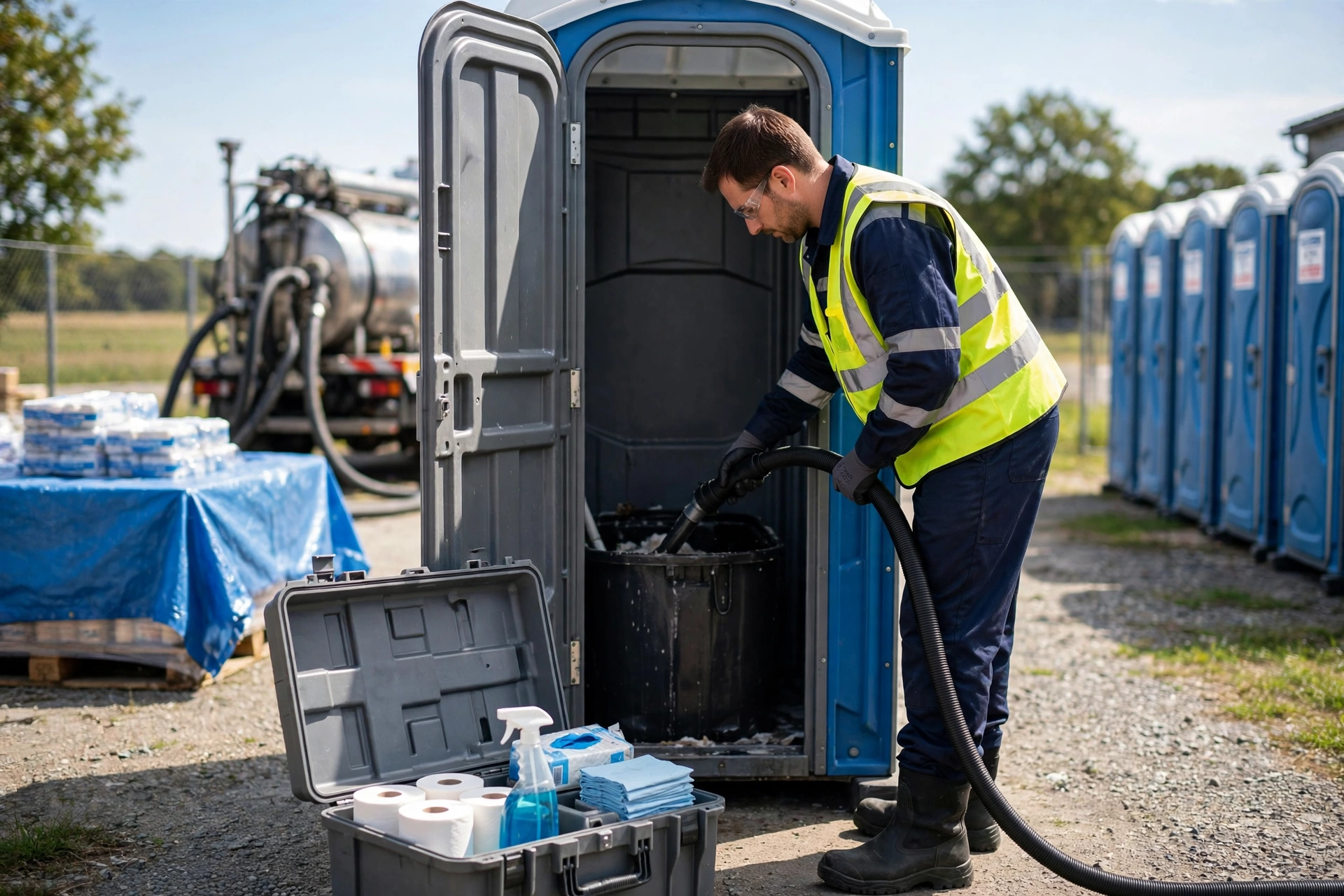
The industry runs on clear standard schedules, and knowing them lets you judge any supplier's proposal in seconds. For construction sites and other long-term placements, weekly servicing is the baseline virtually every supplier in the country uses. Once a week, a service truck visits each unit, pumps the holding tank, cleans and disinfects the interior, restocks supplies, and refreshes the deodorizing chemistry. For events, servicing is scheduled around the event itself: units arrive clean and fully stocked, multi-day events get visits slotted between event days or during low-traffic windows, and single-day events typically need no mid-event servicing unless attendance is very large.
These are baselines, not ceilings — and that distinction is the whole game. The right frequency for your situation depends on how heavily the units are used, the weather, and the duration of the placement. A good supplier recommends a schedule based on your headcount and conditions rather than defaulting to weekly and hoping for the best. Understanding what servicing involves and what drives frequency lets you have that conversation intelligently, recognize when your units need more attention, and evaluate whether a supplier's service program is genuinely thorough or just a pump-and-go operation wearing a uniform.
What Happens During a Proper Service Visit
A real service visit is far more than emptying the tank. Here is what thorough servicing includes, step by step — use this as your standard when evaluating any supplier, including us.
Step 1: Pump the holding tank
The technician connects a vacuum hose from the service truck and pumps the holding tank completely, removing all liquid and solid waste. Tanks are serviced on schedule precisely so they never approach capacity — a tank that is allowed to fill completely is a servicing failure, not a normal occurrence.
Step 2: Scrub and disinfect the interior
The toilet seat, urinal, walls, floor, and door handles get scrubbed and disinfected. High-touch surfaces in a portable toilet need the same attention as any public restroom, and this is the step that separates professional servicing from a quick pump-out. Corners, the seat hinge area, and the floor around the base are where neglect shows first.
Step 3: Restock consumables
Toilet paper, hand sanitizer in the wall dispenser, and paper towels where the unit has a sink — all topped up to full. Running out of paper between visits is one of the most common user complaints in the business, and it is entirely a servicing-planning failure. The restock should be sized to the usage the unit actually sees.
Step 4: Recharge the deodorizing chemistry
Fresh deodorizing fluid goes into the tank. This is the blue liquid that controls odor and helps break down waste, and its effectiveness diminishes as the tank fills — which is why it must be replenished at every visit, not just when someone remembers. In hot weather the chemistry works harder and depletes faster, which is one reason summer schedules tighten.
Step 5: Condition check
The technician checks the door latch and lock, the ventilation screen, the unit's level and stability, and looks for cracks, graffiti, or damage. Problems found here — a broken latch, a tipped unit, a cracked wall — get reported and usually fixed on the spot or scheduled for repair. This five-minute inspection is what keeps small issues from becoming delivery-day-grade problems.
The whole visit takes only minutes per unit when done routinely — which is precisely why routine matters. Regular short visits prevent the compounding neglect that turns a unit unsanitary. When comparing suppliers, ask them to describe their service visit in this level of detail. Vague answers are a red flag; specific, confident ones are the mark of an operation that does this thousands of times a week.
What Drives Frequency Up: Usage, Heat, and Headcount
Weekly servicing assumes moderate use. Several factors push a site past that baseline, and recognizing them early is the difference between a schedule that holds and one that fails visibly.
Headcount and usage intensity
The most obvious driver. A unit serving a large crew fills dramatically faster than one serving a handful of workers, and at a certain point the math simply requires more frequent visits. Event dynamics are even more extreme — a unit at a beer garden during a summer festival can work harder in a single day than a jobsite unit works in a week. Tell your supplier the real headcount, not the optimistic one.
Heat
Heat is the great accelerator. Warm weather increases fluid intake and therefore usage, speeds bacterial activity and odor, and depletes deodorizing chemistry faster. Suppliers in southern states routinely increase summer service frequency as a matter of policy, and northern sites see the same effect during heat waves. The first sustained hot spell of the season is the moment to proactively step up frequency — not after the complaints start.
Duration and special situations
The longer a placement runs, the more small issues accumulate, which is why long-term contracts often build in periodic deep cleans beyond the routine visit. Multi-day festivals typically need daily servicing, sometimes with on-site attendants during peak hours. Sites with portable sinks or hand-wash stations need those freshwater tanks refilled and gray-water tanks emptied on their own cadence. High-profile events — weddings, corporate functions — may warrant a pre-event detail clean and a mid-event check even for a single day. The principle never changes: service frequency should match the load.
Warning Signs Your Units Need More Frequent Servicing
Even with a schedule in place, conditions change. Knowing the warning signs lets you call for an adjustment before problems escalate into the kind of situation people talk about.
- Odor noticeable from outside the unit — a well-serviced portable toilet should not announce itself from across the site. Persistent odor means the tank is too full, the chemistry is exhausted, or servicing is overdue.
- Toilet paper or sanitizer running out between visits — usage exceeds the restocking plan and the schedule needs adjusting.
- Tank level approaching the seat — pumping is overdue, full stop.
- Litter or debris accumulating around the unit — the placement area needs attention, not just the interior.
- User complaints — if workers or guests mention the restrooms, take it seriously and immediately. Restroom complaints escalate fast and damage morale or event reputation disproportionately.
- Units being avoided — if the crew starts driving to a nearby gas station instead of using site facilities, something is wrong with the facilities.
- Seasonal shifts — the first sustained hot spell is the predictable trigger. Increase frequency proactively instead of waiting.
A responsive supplier adjusts the schedule mid-contract without drama — it is routine business, not a confrontation. If your supplier resists or is slow to respond to service issues, that tells you something important about the relationship. Reliable servicing is the core of what you are paying for; everything else is logistics.
How Servicing Fits Into Your Quote
A common question is what it costs to empty or pump a portable toilet — and the reassuring answer is that for rental customers, servicing is normally bundled into the rental arrangement rather than billed per pump-out. When you rent a unit for a week, a month, or an event, the quote includes the scheduled service visits appropriate to that rental: weekly visits for construction, pre- and post-event service for events. You are not hiring a pump truck separately or paying per visit under normal circumstances.
What can change the figure is frequency beyond the standard: if your site needs more frequent visits than the baseline, those are additional truck rolls with labor, disposal, and consumables, and the quote reflects that honestly. Emergency or unscheduled callouts — a tipped unit, vandalism, a tank filled far ahead of schedule — may carry a service charge depending on your agreement, which is why callout terms are worth clarifying upfront. The practical advice for comparing bids: compare the servicing explicitly. A supplier quoting weekly service and a supplier quoting a thinner schedule are not offering the same product, and the cheaper headline may simply reflect less service. Ask each supplier what schedule they recommend for your headcount and conditions, what each visit includes, and how unscheduled callouts are handled. The answers reveal more about supplier quality than almost anything else in the quote.
Managing Servicing Over a Long-Term Rental
For multi-month construction or industrial placements, servicing becomes an ongoing operations item worth managing actively rather than setting and forgetting. Start with a written service schedule in the rental agreement — which days, how many visits per week, and what each visit includes. Get it in the paperwork, not just in a phone conversation.
Designate someone on site as the sanitation point of contact: the person who notices the paper running low on Thursday, who calls when a unit gets damaged, who meets the service truck if access requires it. Keep a simple log of service visits — it takes seconds to note the date, it creates accountability on both sides, and it documents that your site maintenance program is real, which matters if OSHA or a client ever asks. Our OSHA compliance guide explains exactly why that documentation matters.
Plan for the phases of your project: crew sizes change between site work, structure, and finishes, and your service frequency should change with them. A quick call to adjust the schedule beats paying for visits you do not need or suffering through weeks when you needed more. Seasonal transitions deserve the same attention — schedule the summer frequency increase before the heat arrives, not after. Finally, maintain the relationship. A supplier who knows your site, your contact person, and your patterns will spot problems before you do and prioritize your callouts. Long-term sanitation is a partnership, and the sites with the fewest restroom problems are invariably the ones where communication flows both ways. Set that tone from the first delivery and the rest takes care of itself.
Servicing Questions, Answered
How often do porta potties need to be serviced?
Weekly servicing is the industry standard for construction and long-term placements. Events are serviced around the event itself, with multi-day events receiving daily or between-day visits. High-use sites and hot weather call for more frequent service.
How often are the tanks emptied?
The holding tank is pumped during every scheduled service visit — weekly for typical construction rentals. Tanks are never left to fill completely; servicing is scheduled so pumping happens well before capacity becomes an issue.
What is included in a porta potty service visit?
A full service includes pumping the tank, scrubbing and disinfecting all interior surfaces, restocking toilet paper and sanitizer, replenishing deodorizing fluid, and a condition check covering the door latch, vents, and stability.
Do I pay separately for pump-outs?
No — for rental customers, servicing is bundled into the rental arrangement and its scheduled visits. Additional visits beyond the standard schedule, or emergency callouts, may be handled separately depending on your agreement, so clarify callout terms upfront.
Do I need to do anything between service visits?
Very little. Designate someone to glance at units periodically for obvious issues like low supplies or damage, and keep the area around units clear for truck access. The supplier handles everything else on schedule.
What if a unit needs service before the scheduled visit?
Call your supplier for an unscheduled visit. Responsive companies handle callouts routinely — tipped units, damage, tanks filling early. Clarify callout procedures and response times when you set up the rental, not when you need them.
Should servicing increase in summer?
Usually yes. Heat increases usage, accelerates odor, and depletes deodorizing chemistry faster. Proactively increasing frequency at the start of sustained hot weather prevents the complaints that follow if you wait for problems to appear.
How do I know if my current servicing is adequate?
Adequate servicing means no persistent odor, supplies that last between visits, tanks nowhere near full, and zero user complaints. If workers or guests mention the restrooms, your schedule needs adjusting — call (855) 343-0136 and we will fix it.
Ready When You Are
One call handles the whole thing: unit selection, delivery scheduling, servicing cadence, and pickup. Call (855) 343-0136 — lines are open Mon–Sat 7am–7pm CST, Sun 7am–12pm CST.
More Guides
- What Affects Porta Potty Rental Cost: 7 Pricing Factors Explained
- How Many Portable Toilets Do I Need? Sizing Guide, Tables & Calculator
- OSHA Portable Toilet Requirements for Construction Sites (2026 Guide)
- Do You Need a Permit for a Porta Potty? Rules by Placement Explained
- What Makes a Porta Potty ADA Compliant? Specs & Requirements