Crowd Sanitation Is a Production Discipline
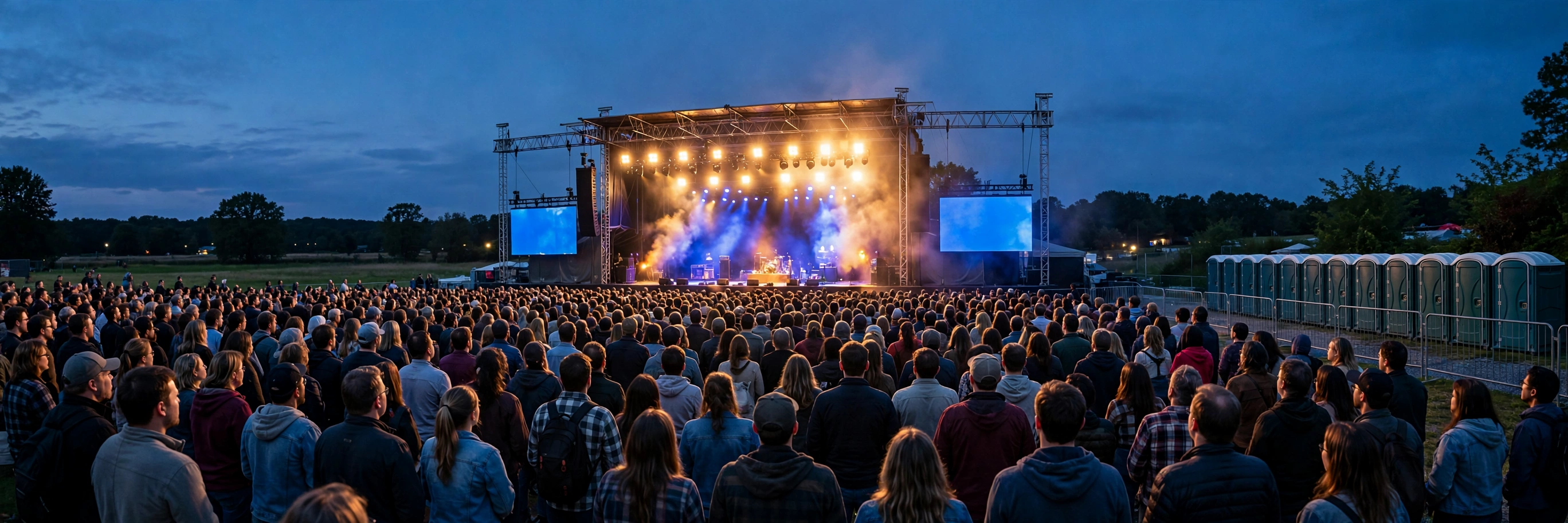
Nobody buys a festival ticket for the restrooms, but everybody remembers them. Too few units and the lines become the story of the day. Dirty units and the photos end up online before the headliner finishes. Festival and concert porta potty rental is crowd engineering: the right number of clean units, arranged in banks where the crowd actually flows, serviced on a schedule built around your gates.
The difference between a festival that feels well-run and one that feels chaotic is often invisible infrastructure — and restrooms are the most personal piece of it. Get the count right, get the placement right, keep them clean through the headliner set, and nobody thinks about bathrooms at all. That is the goal: restrooms nobody notices.
One call to (855) 343-0136 starts the planning. Tell us the venue, the expected peak crowd, the schedule, and whether alcohol is served, and we will build the unit plan — counts, bank layouts, servicing schedule, all of it.
Sizing: Peak Concurrency Rules Everything
Size to peak concurrent attendance, not total ticket sales. A 10,000-ticket festival with 4,000 people on the grounds at once is a 4,000-person restroom problem. A seated amphitheater show where everyone arrives together is a wave problem — the whole crowd hits restrooms in the same thirty minutes before showtime and again at intermission. Different patterns, different plans.
The baseline: roughly one unit per 50 guests for four hours without alcohol. Stretch to eight-plus hours and the number climbs. Add alcohol — and festivals serve alcohol — and add 15 to 20 percent more units on top. Heat pushes it further. A 5,000-peak festival with drinks on a hot day is a 120-plus-unit problem, not a 100-unit problem. Our sizing guide has the full math including duration multipliers.
Then weight the mix. Women's lines are the eternal festival complaint, and the fix is more units designated for the women's side — experienced promoters plan it that way from the start instead of discovering it in the reviews. Add ADA accessible units at every bank: at least 5 percent of the total with a minimum of one per bank. Add hand-wash stations at every food zone. These are not extras; they are the baseline for a professional event. Our ADA accessible units page covers compliant placement.
Bank Layouts That Actually Work
Never cluster all units in one spot. The bank system is the core technique: divide the total count into multiple banks of 8 to 20 units, distributed along main walkways and near crowd anchors — stages, food courts, beer gardens, entrances. Guests use the restrooms they can see. Spread banks cut walking distance and distribute demand so no single bank gets crushed while another sits empty.
Worked examples. A 3,000-peak single-day festival: three banks of 12 to 14 units — one near the main stage, one at the food court, one by the entrance — plus ADA at each bank and hand-wash at the food court. A 10,000-peak multi-day festival: six to eight banks of 15 to 20 across the grounds, the largest banks at the main stage and the campground entrance, smaller satellite banks at secondary stages. The exact split follows your site map; we plan it with you against the real layout.
Keep restrooms at least 20 feet from food prep — 50 is better for guest comfort — on the downwind side wherever the site allows it. Set banks back just enough from walkways that queues do not block pedestrian flow, but keep them visible: wayfinding signage at every major intersection pointing to the nearest bank. At night, every bank needs lighting on the approach and inside the units — string lights on the bank, area lighting from your production setup, or battery lanterns in each unit. A dark restroom bank is a bank nobody uses, which means the lit one gets destroyed.
Ground rules for every bank: firm, level footing, truck access for servicing confirmed in advance, and a wet-weather backup layout if the forecast looks soft. Heavy rain turns turf into a servicing nightmare — plan the backup before you need it, not during the downpour. Our placement guide covers the ground and access checklist.
Units, Upgrades, and the VIP Question
Standard units handle the bulk: self-contained, vented, stocked with paper and sanitizer. Near VIP, hospitality, and artist areas, upgrade to deluxe flushable units with real sinks and mirrors — the people who paid premium prices notice the difference, and the upgrade is small against the production budget. For the top tier — headliner hospitality, sponsor lounges, backstage — a luxury restroom trailer with flushing porcelain and climate control is the move.
Hand-wash stations go at every food zone and at the largest banks — roughly one station per 8 to 10 units at food-adjacent banks. For multi-day festivals with camping, shower trailers at the campground change the entire attendee experience and cut complaints to near zero. Clean hands and a hot shower turn a dusty weekend into a good memory.
Attendants are the highest-leverage upgrade in festival sanitation. At the main banks during peak hours, an attendant restocks continuously, wipes down units between scheduled services, manages lines politely, and fixes problems before they become social media posts. For crowds over a few thousand or events past six hours, budget for attendants at the two or three busiest banks. It is the cheapest reputation insurance in the business.
Servicing Across Multi-Day Runs
Multi-day festivals live or die on the service schedule. Full pump-outs and restocks happen in the overnight or early-morning window before gates open. Daytime touch-ups — paper, sanitizer, wipe-downs — hit the banks during natural lulls in the schedule. The service plan goes on the production run sheet, coordinated with your production manager, because the pump truck needs clear routes and festival layouts change daily.
Give the driver a site contact with a radio or phone number. A bank that was accessible yesterday sits behind a new merch tent today — that is festival life, and the service plan flexes with it. For the biggest events, we stage a service tech on site during peak hours for immediate response instead of waiting for the next scheduled window.
Tank capacity planning matters more than most promoters expect. A bank of 20 units serving a heavy-drinking evening crowd can need a mid-event pump, not just a restock — and discovering that at 10 p.m. on Saturday is a disaster. We plan service frequency from your schedule, your crowd, and your bar program, and we would rather over-service a bank than watch it fail during the headliner.
Real Festivals and Shows
Two-day Americana festival, 4,000 peak, beer garden. Five banks of 14 units, ADA at each bank, hand-wash at the food court, deluxe units at the VIP deck. Overnight full services, daytime touch-ups, attendants at the two main-stage banks through the evening sets. Zero restroom complaints in the post-event survey — the promoter's words, not ours.
Single-night amphitheater concert, 6,000 seats, 3 hours. A wave problem: 60 units split across four banks at the concourse level, pre-show and intermission touch-ups timed to the setlist. The intermission rush cleared in under fifteen minutes and the second set started on time.
Three-day camping festival, 8,000 peak. Eight banks across the grounds plus the campground, shower trailers at camp, daily full servicing with an on-site tech during peak hours. The campground banks got twice-daily service — camping crowds use restrooms at all hours, and the schedule matched reality.
Downtown street festival, 15,000 over two days. Banks at every third block along the route, ADA at each bank, hand-wash at the food vendor rows. Tight urban placement with truck access planned around street closures — the service windows were coordinated with the city's barricade schedule.
Permits, Health Departments, and Paperwork
Most jurisdictions require a permit or at least a notification for large temporary gatherings, and the restroom plan is part of the application. Health departments want unit counts, servicing schedules, and hand-wash provisions in writing — we provide the documentation from our side so your permit file is complete. Start the paperwork early: permit offices do not move at festival speed, and a missing restroom plan is one of the most common reasons event permits get held up.
Keep delivery confirmations and service logs with your event file. If an inspector walks the grounds mid-event, a documented servicing schedule answers every question before it is asked. And confirm your event liability policy covers temporary structures — it almost always does, but the question takes five minutes and prevents an ugly surprise.
Straight Answers
How many units does a 5,000-person festival need?
For 5,000 peak concurrent attendees over eight hours with alcohol, start around 120 units across six to eight banks, plus ADA at each bank and hand-wash at food zones. Without alcohol or for shorter events the number drops. Share your schedule, layout, and bar program and we will spec it precisely.
How far in advance should we book festival restrooms?
Two to four weeks is comfortable for most events; large festivals and peak-season dates from May through October book further out. Short-notice is often possible — call even if the date is close. Our booking lead-time guide has the details by event size.
Can units go on grass?
Yes, on firm level grass. Soft saturated turf is a problem for both the units and the delivery truck, so have a hard-surface backup if rain is forecast. We set units on mats to protect delicate lawns and keep them level.
Do standard units need power or water?
No. Standard units are fully self-contained with onboard holding tanks. Restroom trailers, lighting packages, and flushable upgrades may need power or water — we spec that with you during planning so there are no surprises on event day.
What happens if it storms mid-festival?
Units handle rain and wind when staked or sited against windbreaks. The real risk is saturated ground blocking service access — that is why we confirm firm placement in advance and keep a backup layout ready. Severe weather calls get coordinated directly with your production team.
Should we hire attendants?
For crowds over a few thousand or events past six hours, yes — at least at the busiest banks. Attendants restock continuously, wipe down between services, manage lines, and catch problems before guests do. It is the single most noticeable upgrade you can buy.
Building the Unit Plan: The Math, Worked
Every festival is a math problem with three inputs: peak concurrent crowd, event hours, and whether alcohol is served. Nail those three and the unit count builds itself. Guess at them and you end up with lines or empty units — both cost you, one in reputation and one in wasted budget. Here are the starting baselines we work from:
| Peak concurrent crowd | 4 hours, no alcohol | 8 hours with alcohol |
|---|---|---|
| 500 | 10 units | 12 units |
| 1,000 | 20 units | 24 units |
| 3,000 | 60 units | 72 units |
| 5,000 | 100 units | 120 units |
| 10,000 | 200 units | 240 units |
These are starting baselines, not quotes carved in stone. Heat pushes the numbers up. A young crowd drinks more water and uses facilities more often. A seated show with two set breaks is a wave problem that needs surge capacity at the banks, not just a bigger total. Share your schedule, your crowd profile, and your bar program, and we tune the plan to your reality instead of a chart.
- Women's split: on crowds over a few thousand, designate roughly 60 percent of general units for the women's side. The women's line is the most photographed failure in live events. Plan it away.
- ADA minimum: at least 5 percent of the total count, with a minimum of one ADA unit at every bank. Non-negotiable at public events.
- Hand-wash: one station per 8 to 10 units at food-adjacent banks, plus one at every bank over 15 units.
- Campgrounds: count campers separately from day attendees — overnight crowds use restrooms around the clock, so camp banks get their own math.
Logistics Walkthrough: Booking to Pickup
The unit plan is half the job. The other half is the run sheet — every delivery, service window, and pickup locked to your production timeline. Here is how a typical festival engagement runs:
- 6 to 8 weeks out: planning call with your site map. We lock counts, bank placement, unit mix, trailer and attendant add-ons, and the service schedule. Contract signed, date held.
- 2 weeks out: final headcount update, weather watch begins. Service windows go on your production run sheet with a named site contact and phone number for our driver.
- Load-in day: units arrive in the delivery window, placed per the marked site map. Driver walks the placement with your production contact, confirms truck access for service days, and flags anything that changed since the plan.
- Show days: pre-gates check — every unit stocked, vented, door-latching. Touch-up services hit the banks during schedule lulls. Attendants staff the main banks through peak sets. Our on-call line stays open for the oh-no moments.
- Overnight: full pump-outs, deodorizer recharge, and restocking before gates open the next day. The pump truck needs clear routes — keep the service lanes open on the overnight run sheet.
- Teardown: final service after the crowd clears, pickup inside your load-out window. Unit counts verified against the contract before the truck leaves.
The single most common planning failure: the service schedule never makes it onto the production run sheet. The pump truck shows up at 2 a.m. to a locked gate and a new merch tent blocking the bank. Put the service windows on the sheet, give the driver a contact with a radio, and multi-day festivals run clean. Our booking lead-time guide covers how early to start by event size.
Venue Scenarios: Same Crowd, Different Ground
The crowd math barely changes between venues. The ground, the access, and the constraints change everything. Four patterns we see constantly:
Fairgrounds and Open Fields
The forgiving option: truck access everywhere, room to spread banks along natural walking routes, space for the big main-stage banks. The risk is soft ground. One heavy rain turns turf into a servicing nightmare, so we set banks on mats, confirm a hard-surface backup layout in advance, and keep the service lanes on the highest, firmest ground. Staking every unit is standard — open fields catch wind, and a tipped unit in front of 5,000 people is a story nobody wants.
Downtown Streets and Urban Sites
Placement is negotiated with the city, not chosen freely. Units go in after barricades go up and come out before streets reopen — tight windows, precise execution. Service access is the hard part: coordinate pump windows with the street-closure schedule or the truck cannot reach the banks. ADA units must sit on hard, level surface with step-free routes — plan those spots first, then fit the standard banks around them. Urban festivals live or die on the city's barricade schedule, so our service windows get built around it.
Campground Festivals
Two separate restroom problems: the venue grounds and the campground. Camp banks get twice-daily service — campers use restrooms at all hours, and the math has to match that reality. Place banks near camp loops where foot traffic already flows, keep approaches lit all night, and put banks where event security already patrols. Shower trailers at the campground are the highest-complaint-killer in the business: clean hands and a hot shower turn a dusty weekend into a good memory. Coordinate the shower trailer's power and water needs during booking, not on load-in day.
Amphitheater Lawns and Venue Grounds
Here the portable units supplement permanent restrooms, so the plan starts with a real question: what can the venue's own facilities handle? We size the portable banks to cover the gap, placed on the concourse and lawn where the lines form — not hidden behind the venue where nobody walks. Wave timing rules everything: pre-show and intermission rushes need surge capacity and touch-up services timed to the setlist. For the premium lawn and box areas, a luxury restroom trailer or deluxe flushable units keep the experience consistent with the ticket price.
More Straight Answers
How do you fix the women's line problem?
By planning for it instead of discovering it. We designate roughly 60 percent of general units for the women's side on crowds over a few thousand, place the women's banks closest to the main stages where demand concentrates, and station attendants at the busiest banks during peak sets to keep lines moving. It is the most visible restroom failure at any festival, and it is entirely preventable.
What if ticket sales outrun our unit plan?
Tell us the moment you see it coming. We can add units up to the delivery window and often on event day if inventory is staged nearby — early calls get first priority on extra stock. This is why the contract includes a headcount-update checkpoint two weeks out: catching a surge early beats scrambling on show day.
Who handles trash and mess around the units?
We handle everything inside and on the units: pump-outs, wipe-downs, restocking. Grounds trash around the banks is the promoter's, but booked attendants police the bank areas as part of their rounds — keeping the approaches clear is half of keeping the experience clean. Set the expectation in the contract so nobody assumes the other side has it.
How do you handle security and vandalism at the banks?
Placement is the first defense: banks go where event security already patrols, approaches stay lit all night, and banks stay visible rather than tucked into dark corners. On multi-day events we can reposition or consolidate banks overnight near staffed areas. Staked units, locked service panels, and attendants at the main banks handle the rest. A well-lit, well-staffed bank is a bank nobody messes with.
Ready When You Are
One call handles the whole thing: unit selection, delivery scheduling, servicing cadence, and pickup. Call (855) 343-0136 — lines are open Mon–Sat 7am–7pm CST, Sun 7am–12pm CST.
Related Services
- Construction Porta Potty Rental
- Event Porta Potty Rental
- Wedding Porta Potty Rental
- Luxury Restroom Trailer Rental
- ADA Portable Toilet Rental
- Deluxe Flushable Porta Potty Rental
Serving all 48 contiguous states and Washington DC — see all locations.