Sanitation Is First In and First Critical
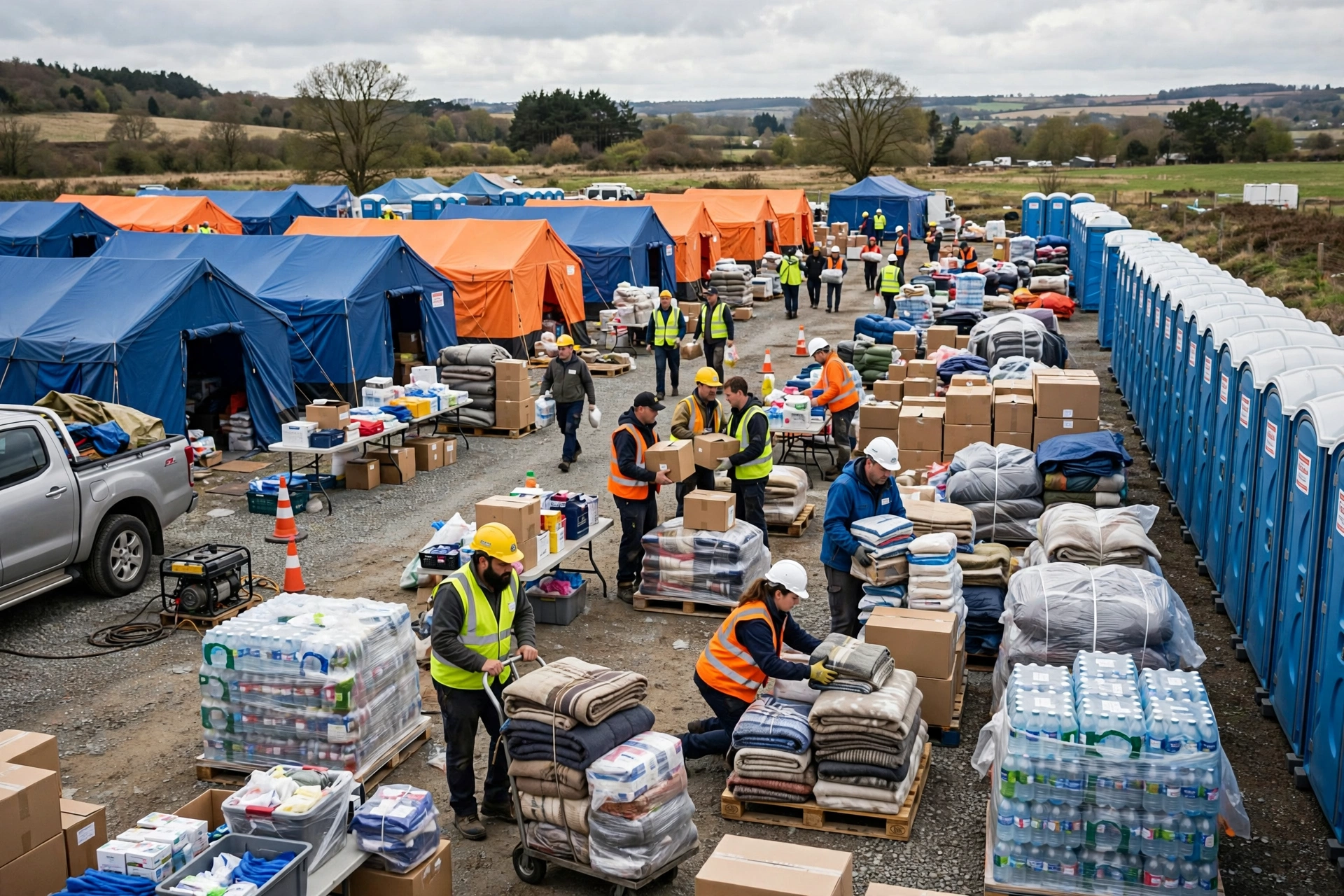
After a hurricane, a tornado, a flood, or a wildfire, sanitation is one of the first things a community loses and one of the last things anyone plans for. Homes are damaged or gone. Water systems fail. And thousands of people — displaced residents, volunteers, utility crews, first responders — need restrooms with no infrastructure to support them. Disaster relief portable toilets close that gap fast.
This is not event rental with a different label. Disaster deployment is its own discipline: rugged equipment, rapid staging, servicing on a relentless schedule, and scaling that follows the response as it moves from rescue to recovery to rebuilding. We have run this playbook through storm seasons across the country, and the pattern is consistent every time.
The first 48 hours are about getting basic units to shelters and command posts — anywhere people are already gathering. The weeks after are about sustaining them: pumping on tight rotations, restocking through volunteer surges, and holding the line until infrastructure comes back. Call (855) 343-0136 to start a deployment.
Who Orders Disaster Sanitation
Emergency management agencies and county officials standing up shelters and staging areas. Relief organizations and nonprofits running volunteer bases and feeding operations. Utility companies housing line crews for multi-week restoration work. Faith-based and community groups sheltering displaced residents. Contractors on debris removal and rebuilding contracts. Any operation where people are working or sheltering without functioning plumbing.
If you are coordinating a response, designate one logistics contact for sanitation and give us their direct number. Deployments move fastest with a single decision-maker who can approve placement sites, unit counts, and service schedules. We work with that contact from the first call through demobilization — no committee, no telephone game.
For smaller-scale emergencies — a single facility, a flooded business, a localized outage — our same-day emergency rental handles rapid response. Disaster relief deployment is the scaled-up version: dozens to hundreds of units, sustained servicing, phased over weeks and months.
What Deploys and Where It Goes
The standard deployment mix: standard portable toilets in banks at shelters, staging areas, supply distribution points, and volunteer check-in. ADA accessible units at every public-facing site — disasters do not suspend accessibility needs, and displaced populations include elderly residents and people with disabilities at high rates. Hand-wash stations at feeding stations, medical tents, and every restroom bank. Shower trailers for volunteer bases and crew camps where people are stationed for days.
Placement in a disaster zone follows different rules than a planned event. Ground may be soft or debris-covered. Power may be out. Roads may be partially blocked. We scout placement with your logistics contact: firm ground the truck can reach, clear of floodwater and debris fields, with room for ongoing service access. Units go where people already gather — shelters, distribution points, check-in lines — because in a crisis, restrooms must be found, not searched for.
Conditions dictate the details. High-wind events get staking and windbreak siting. Flood zones get elevated or relocated placement as water moves. Wildfire areas get upwind siting away from smoke and ash drift. The equipment is rugged, but placement is where disaster deployments succeed or fail — and we plan it with your team, not around them.
How a Deployment Rolls Out
First call: what happened, where, how many people need support, who the logistics contact is. We spec an initial deployment — unit types, counts, placement zones — and start rolling trucks. The first wave prioritizes shelters and command posts. Follow-on waves fill out volunteer bases, distribution points, and neighborhoods as your team identifies them.
For agencies and organizations, we work inside your procurement process. Delivery confirmations, service logs, clear rental terms — the documentation your finance people need. Mention your process on the first call so the paperwork moves in parallel with the trucks, not behind them.
Scaling is continuous, not one-and-done. Volunteer surges arrive in waves. Donations bring more volunteers. Utility restoration moves block by block. The deployment flexes with all of it: units added where the crowds go, pulled back where the need drops, service schedules tightened or relaxed as conditions change. Every rental includes delivery, setup, scheduled servicing, and pickup — at disaster scale, that means the full logistics chain, managed.
Servicing in a Disaster Zone
Disaster servicing is the hardest service in the business: extreme heat, mud, debris, limited access, and usage rates far above normal. We run tighter rotations than standard — often multi-weekly or daily at the hardest-hit sites — and every visit is the full treatment: pump-out, deodorizer recharge, interior wipe-down, restock of paper and sanitizer. In a disaster zone, a clean restroom is a morale event.
Heat is the silent killer of sanitation schedules. Summer deployments fill tanks faster and breed odor faster, which is why service frequency goes up with the temperature. Winter deployments bring their own problem: freeze-thaw cycles and mud. We adjust the rotation to the season and the site, and we watch the high-traffic banks — shelter entrances, feeding lines — more closely than the rest. Our servicing frequency guide covers the baseline; disaster schedules run hotter than baseline by design.
Communication keeps the schedule honest. Your logistics contact gets the service plan up front and a direct line for when conditions change: a road closes, a shelter moves, a volunteer surge doubles the headcount overnight. The schedule adapts same-day. Rigid plans die in disaster zones; responsive ones hold.
Sizing a Deployment
Disaster sizing runs hotter than event sizing. Plan roughly one unit per 25 to 40 people per day at a shelter — people are on site around the clock, not for four hours. A 500-person shelter needs 12 to 20 units as a working baseline, split across two or three banks so no single bank becomes a bottleneck. Add ADA units at every bank and hand-wash stations at a ratio of about one per four to six units.
- Shelter, 200 residents: 6 to 8 standard units, 2 ADA units, 2 hand-wash stations, daily or multi-weekly service.
- Volunteer base, 100 workers: 4 to 5 units plus a shower trailer, hand-wash at the feeding area.
- Staging area or command post, 50 staff: 2 to 3 units, one hand-wash station.
- Distribution point, high turnover: 2 to 4 units positioned at the queue, not behind it — people in line need restrooms in line.
- Crew camp, multi-week: units plus shower trailers and hand-wash stations at the mess area, serviced on a fixed weekly-plus rotation.
These are starting points. Real deployments get re-sized in the first 72 hours as actual usage patterns emerge — and that re-sizing is part of the service, not a change order. Our portable toilet sizing guide covers the baseline math for planned events; disaster math starts from the same principles with heavier usage multipliers.
The Long Tail: Recovery and Demobilization
The cameras leave after a week. The portable toilets stay for months. Rebuilding phases bring contractor crews who need jobsite sanitation for the duration — and at that point the deployment transitions naturally into standard construction service with weekly rotations. Volunteer operations wind down in phases. Shelters consolidate. The sanitation plan follows each phase instead of fighting it.
Demobilization is phased, never abrupt. Units come off sites in waves as infrastructure returns and your logistics contact confirms each site is ready. No site loses restrooms before its replacement is working — that is the rule. Final pump-outs, load, gone, with service logs closing out the deployment file for your records.
Real Deployments
Gulf Coast hurricane, 800-person shelter. First wave: 20 standard units, 4 ADA, 6 hand-wash stations, two banks flanking the shelter entrance. Daily service through the first two weeks, then multi-weekly as the shelter consolidated. Total deployment: eleven weeks, phased demobilization as residents returned home.
Midwest tornado, volunteer base and debris corridor. Volunteer check-in got 8 units and a shower trailer; the debris corridor got units leapfrogging with the work crews as they cleared block by block. Staking and windbreak siting after a storm cell passed through the recovery zone mid-deployment.
Western wildfire, utility crew camp. Line crews staged for a six-week restoration: 10 units, 2 ADA, shower trailer, hand-wash at the mess tent. Upwind siting away from smoke drift. Servicing three times weekly in extreme heat, with the rotation tightened during the hottest stretch.
River flood, distribution point and shelter pair. 12 units split between a supply distribution site and a 300-person shelter, elevated placement as water levels shifted, daily service at the distribution point where foot traffic was heaviest. Demobilized in three phases over two months.
Straight Answers
How fast can units deploy after a disaster?
Initial deployments can often roll within a day of the call during open hours, with follow-on waves as your team identifies sites. Call as early as possible — demand surges regionally after major events, and early callers get first staging priority.
What equipment works best at a shelter?
Standard units in banks for general use, ADA accessible units at every public-facing site, hand-wash stations at feeding areas and restroom banks, and shower trailers where people are housed overnight. The mix scales with the shelter population and gets re-sized in the first 72 hours.
How is servicing handled in a disaster zone?
On tighter rotations than normal — often multi-weekly or daily at hard-hit sites — with a full pump-out, deodorizer recharge, wipe-down, and restock every visit. Heat, mud, and usage rates drive the schedule, and it adapts as conditions change.
Can you support a multi-month recovery?
Yes. Deployments scale down in phases as infrastructure returns, contractor crews transition to standard jobsite service, and demobilization is coordinated with your logistics contact so no site loses restrooms before its replacement is working.
Do you work with government agencies and nonprofits?
Yes. We provide delivery confirmations, service logs, and clear rental terms that fit procurement and finance requirements. Mention your process on the first call so the paperwork moves in parallel with the trucks, not behind them.
What if roads are blocked or the site has no power?
Standard units need no power or water — they are fully self-contained, which is exactly why they are the backbone of disaster response. For blocked routes, we stage with your logistics contact and adjust placement as access opens. Shower trailers need power and water planning, which we sort out on the first call.
Ready When You Are
One call handles the whole thing: unit selection, delivery scheduling, servicing cadence, and pickup. Call (855) 343-0136 — lines are open Mon–Sat 7am–7pm CST, Sun 7am–12pm CST.
Related Services
- Construction Porta Potty Rental
- Event Porta Potty Rental
- Wedding Porta Potty Rental
- Luxury Restroom Trailer Rental
- ADA Portable Toilet Rental
- Deluxe Flushable Porta Potty Rental
Serving all 48 contiguous states and Washington DC — see all locations.