Event Restrooms Your Guests Will Not Complain About
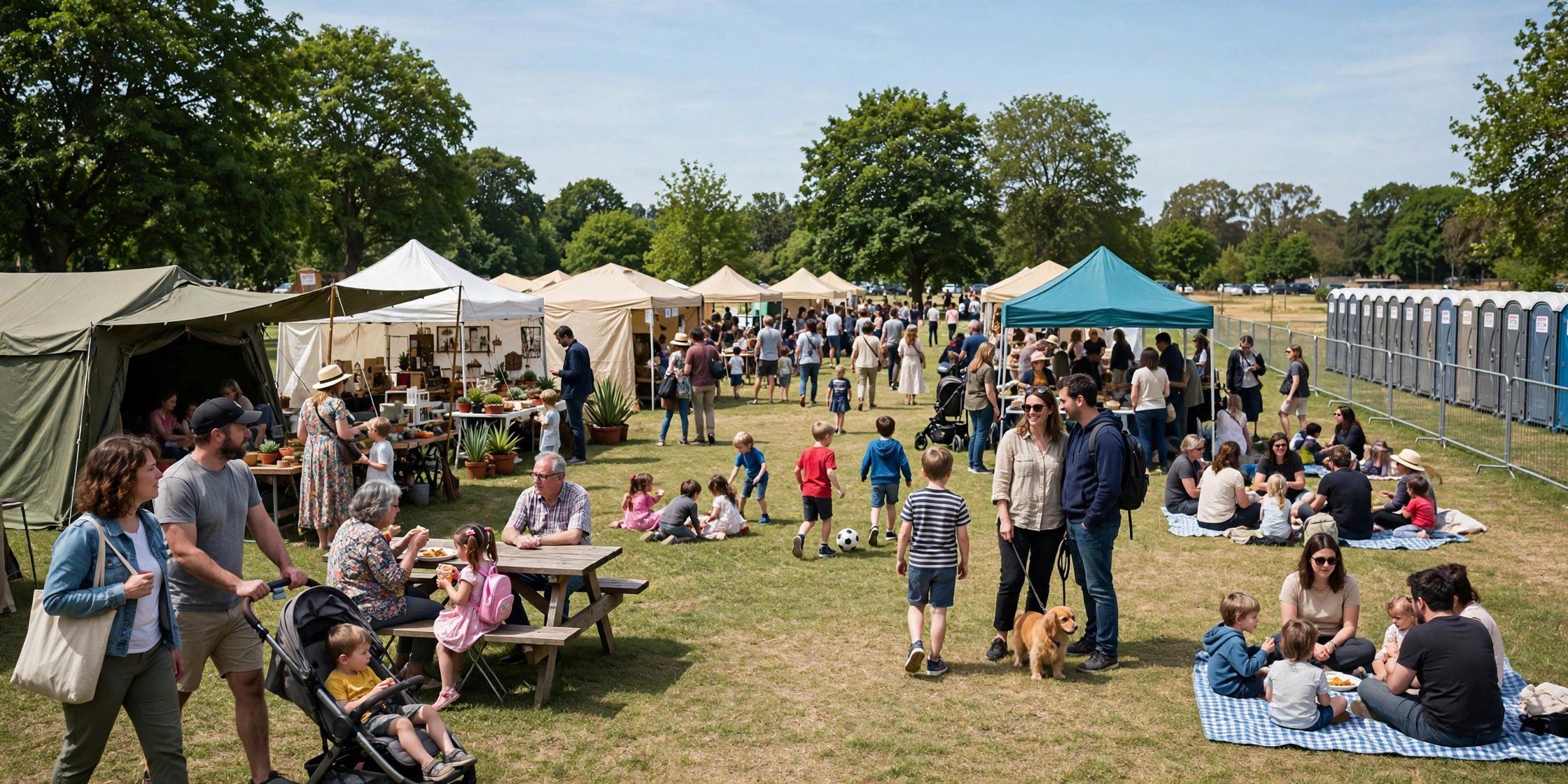
Ask anyone who plans outdoor events what keeps them up at night, and restrooms make the list every time. Too few units and the lines become the story. Dirty units and the photos end up online. Event porta potty rental is the fix: the right number of clean units, placed where crowds actually flow, serviced on a schedule built around your gate hours. You run the event. We make sure nobody thinks about the bathrooms.
Sizing starts with peak concurrent attendance — not total ticket sales. A 5,000-ticket festival with 2,000 people on the grounds at once sizes very differently from a seated show where everyone arrives together. The baseline is roughly one unit per 50 guests for four hours without alcohol. Stretch the hours, add drinks, add heat, and the number climbs. Serving alcohol? Add 15 to 20 percent more units. That is not a suggestion — it is the difference between steady turnover and lines across the midway.
Placement is the other half. Spread units across multiple banks along main walkways and near anchors like stages and food areas — never one giant cluster in a corner. Keep restrooms at least 20 feet from food prep, on the downwind side, on firm level ground the truck can reach. Guests use the restrooms they can see. Make them visible, make them reachable, make them clean.
Who Rents Event Units
Festival promoters, fair boards, concert venues, parks departments, race organizers, community groups, churches, schools, and anyone putting more than a few dozen people on a field for a few hours. Single afternoon gatherings and three-day festivals both fit — the plan scales, the equipment is the same clean fleet, and the servicing schedule stretches to match your run.
If this is your first event, lean on us for the sizing. Tell us the expected peak crowd, the schedule, the layout, and whether alcohol is served, and we will build the unit plan. If you are a veteran promoter, give us the numbers and the site map and we will execute. Either way, one call to (855) 343-0136 gets it moving.
The Units and the Setup
Standard units handle the bulk of most events: self-contained, vented, stocked with paper and sanitizer. Upgrade paths are straightforward. Deluxe flushable units with real sinks and mirrors near VIP and hospitality areas. ADA accessible units at every major bank — plan at least one per bank, more for big crowds. Hand-wash stations by every food zone. For the premium tier, restroom trailers with flushing porcelain and climate control.
Evening events need light. Standard units do not have interior lighting, so plan for it: string lights on the bank, solar path markers, or area lighting from your production setup. Pair that with clear wayfinding signage at every major intersection and the route stays obvious after dark. A five-dollar battery lantern inside each unit is the cheapest guest-experience upgrade in the business.
Delivery Day and Multi-Day Servicing
Delivery lands inside your vendor load-in window. Spots marked, gates open, ground confirmed firm — we confirm all of it the day before so the truck rolls straight in and out. Have a wet-weather backup layout ready if the forecast looks soft; heavy rain turns turf into a problem for placement and service access alike. High winds get staking or windbreak siting.
Multi-day events live or die on the service schedule. We build it around your gates: full pump-outs and restocks in the overnight or early-morning window, daytime touch-ups for paper, sanitizer, and wipe-downs during peak periods. Coordinate access with your production manager — the pump truck needs a clear route, and festival layouts change daily. For the biggest crowds, an on-site attendant at the main banks is the highest-leverage upgrade available: continuous restocking, line management, and problems fixed before guests notice.
Pickup runs the morning after the event, once the crowd clears and the truck has a clean shot in and out. Venues requiring same-night removal get staffed for it — tell us up front. We confirm the pickup window with your site contact during booking so teardown crews and our driver never conflict.
Sizing Guidance by Event Type
Backyard party, 50 guests, 4 hours: two standard units. Simple, done. Community 5K, 300 runners plus spectators, 5 hours: six to eight units split between the start/finish area and parking. All-day festival, 2,000 peak attendance, alcohol served: start around 40 units across four to six banks, plus ADA units at each bank, hand-wash stations at food zones, and overnight servicing. Evening concert, 1,000 seated, 3 hours, drinks: roughly 20 units with a mid-show touch-up.
These are starting points, not quotes. Your layout, your crowd behavior, and your schedule shift the numbers. The full math — including duration multipliers and the alcohol adjustment — is in our sizing guide. When in doubt, round up. Running out of capacity mid-event is the one restroom problem you cannot fix after gates open.
Straight Answers
How far in advance should I book event restrooms?
Two to four weeks is comfortable for most events. Large festivals, holiday weekends, and peak season from May through October book out further ahead. Short-notice events are often still possible — call even if your date is close.
Can units go on grass?
Yes, on firm, level grass. Soft saturated turf is a problem for the units and the truck, so have a hard-surface backup if rain is forecast. We can set units on mats to protect delicate lawns.
Do standard units need power or water?
No. Standard units are fully self-contained with onboard holding tanks. Restroom trailers, lighting packages, and flushable upgrades may need power or water — we spec that with you during planning.
Should I add an attendant?
For crowds over a few hundred or events past six hours, yes. Attendants restock continuously, wipe down units between services, and keep lines moving. Guests notice the difference immediately.
What happens if it rains?
The units handle rain fine. The risk is saturated ground complicating service access, which is why we confirm firm placement spots in advance and keep a backup layout ready. High winds get staking or windbreak siting.
How Many Units: The Quick Numbers
Forget total ticket sales. Size to peak concurrent attendance — the number of people on the grounds at the busiest hour. Then apply the multipliers: alcohol adds 15 to 20 percent, events past six hours need a bump, and summer heat pushes usage up across the board. The quick numbers below assume four-to-six-hour events without alcohol unless noted.
- 100 guests, 4 hours: 2 to 3 units.
- 250 guests, 6 hours: 5 to 6 units — make it 7 with alcohol.
- 500 guests, full day: 10 to 12 units across two or three banks, plus at least one ADA unit per bank.
- 1,000 guests, 8 hours, alcohol: 20 to 24 units, daytime touch-ups, and an attendant at the main bank.
- 2,000 peak attendance, multi-day, alcohol: 40-plus units across four to six banks, overnight pump-outs, hand-wash stations at every food zone.
The alcohol multiplier is the one planners underestimate. Drinks do not just add trips — they compress them into the same peak window, because everyone heads for the restrooms at set break, halftime, or the headliner changeover. If your crowd drinks, size for the surge, not the average.
These are starting points. Your layout, your crowd, and your schedule move the numbers, and the full math lives in our sizing guide. When you are between two numbers, take the higher one. Running out of capacity mid-event is the one restroom problem you cannot fix after the gates open.
Delivery Day: What Actually Happens
Delivery lands inside your vendor load-in window, confirmed the day before. The truck rolls in, and the driver works the placement plan with your site contact: banks along main walkways, near stages and food areas, on firm level ground the truck can reach for servicing. Every unit comes off leveled, stocked, and checked — latches, vents, dispensers. On big sites the driver walks the full route before placing, because a bank that looks right on a map can sit behind a fence line in real life.
What we need from you: the load-in window, marked spots or a walk-through with your production lead, gate codes, and a heads-up on soft ground or low clearances. If rain is in the forecast, we finalize the wet-weather backup layout together before the truck rolls. Delivery day is the one day the whole event's restroom plan gets built — twenty minutes of attention here saves headaches for the entire run.
More Straight Answers
How fast is pickup after the event?
Most pickups run the morning after, once the crowd clears and the truck has a clean route in and out. Venues that require same-night removal get staffed for it — tell us during booking and we plan the crew around your teardown.
Can units be secured overnight at a multi-day event?
Yes. Units can be chained together or fenced inside your secured perimeter overnight, and we coordinate the morning service window with your production manager so the pump truck hits every bank before gates open.
Should vendors and staff get separate units?
On big events, yes. A small dedicated bank near vendor row or the production office keeps your crew out of the guest lines and keeps the guest banks sized for guests. It is a small add that your staff will thank you for.
What if attendance beats the estimate?
Call us. If inventory is available we add units and shift the service schedule up. This is exactly why we tell planners to book the high end of their estimate — adding mid-event is possible, but booking right the first time is cleaner.
Crowd Flow: Where Lines Actually Form
Lines do not form evenly. They form at the bank nearest the beer garden, the stage exit, and the main entrance — everywhere the crowd bottlenecks at once. The fix is not just more units, it is more units in the right places: a bigger bank at the high-traffic anchors, smaller banks spread along the walkways to bleed off the flow. Watch where your crowd queues for everything else — food, merch, entry — and put restroom capacity upstream of those chokepoints. A bank nobody walks past is a bank nobody uses, no matter how many units it holds.
Signage does the rest. Tall flags or banners marking each restroom bank, visible over a crowd, cut wandering and spread the load naturally. Guests take the first restroom they can find — make sure the first one they find is not the only one they find. On your site map, mark every bank and every hand-wash station, and brief your volunteers on the locations. The best-placed restroom plan in the world fails if nobody knows where the restrooms are.
Related Services
- Construction Porta Potty Rental
- Wedding Porta Potty Rental
- Luxury Restroom Trailer Rental
- ADA Portable Toilet Rental
- Deluxe Flushable Porta Potty Rental
- Hand Wash Station Rental
Serving all 48 contiguous states and Washington DC — see all locations.