Here is the question that stalls more event plans than any other: do we order regular portable toilets, or do we spring for a restroom trailer? It sounds like a simple either-or. It is not. A standard portable toilet and a restroom trailer are built for different jobs, they need different site conditions, and they deliver a completely different experience to the person walking through the door. Pick the wrong one and you pay for it in guest complaints, blown logistics, or money spent on comfort nobody asked for. Pick right and nobody thinks about the restrooms at all — which is the entire point.
No sales pitch in this guide. We rent both, and we have watched planners, foremen, and brides get this call right and wrong for years. The wrong choice always follows the same script: somebody ordered on vibes instead of facts. Read this, match the facts to your situation, and the answer gets obvious fast. And if you want a straight recommendation for your specific event or site, Call (855) 343-0136 — sizing this correctly is literally what we do all day.
What a Portable Toilet Actually Is
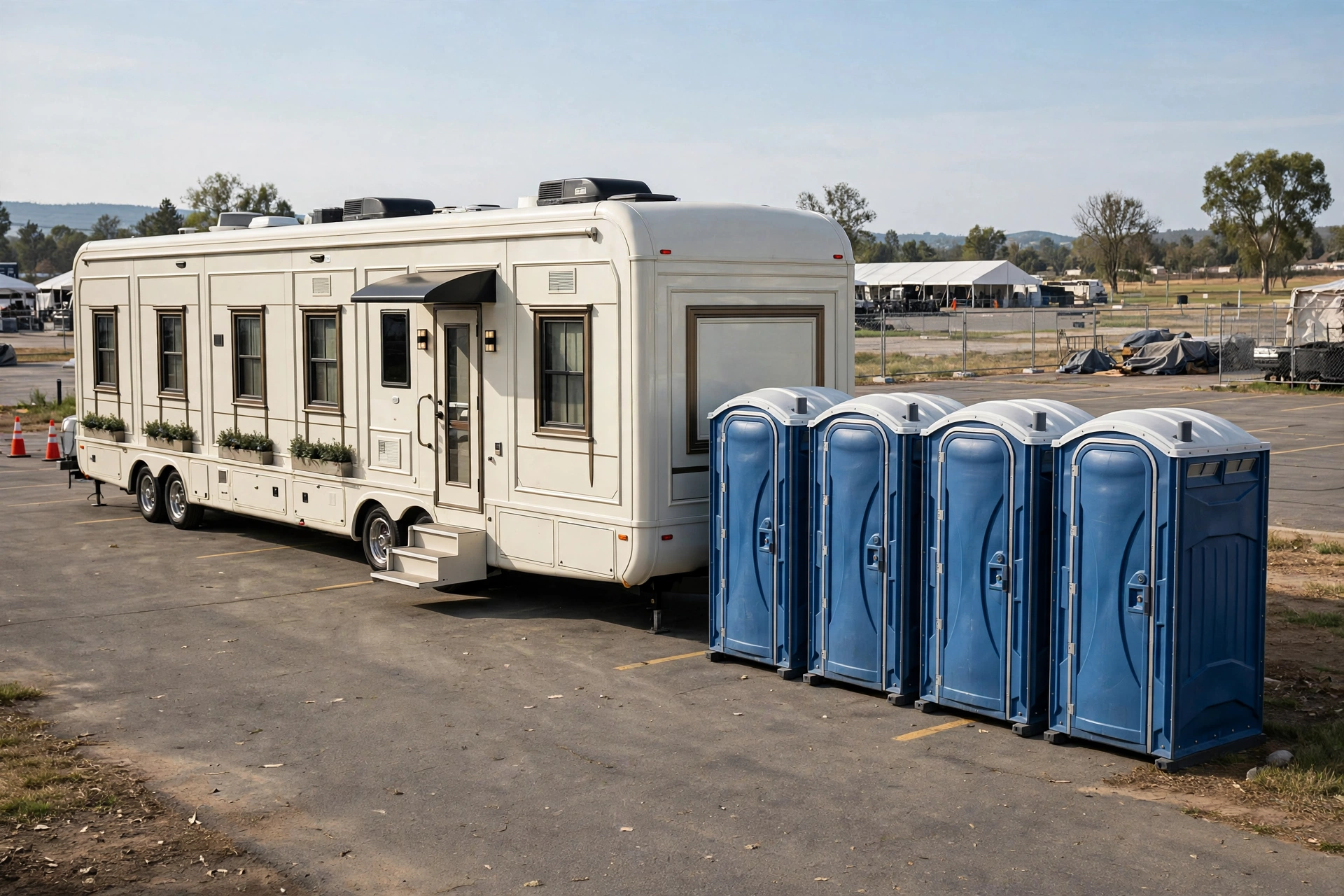
A standard portable toilet is a self-contained molded unit: holding tank underneath, toilet seat and urinal above, hand sanitizer dispenser on the wall, vent stack on the roof pulling air up and out. It needs nothing from your site. No power. No water. No hookups. A truck drops it on flat ground, levels it, stocks it, and it is ready for business in minutes. That independence is the whole superpower. If a truck can reach the spot, a portable toilet can work there — muddy field, active jobsite, mountain venue, downtown alley.
The category has range. Standard units are the workhorse: tough, simple, built to take daily abuse from full crews. Deluxe flushable units add a real flush, a freshwater tank, a sink with running water, and more elbow room — no hookups needed. ADA-compliant units bring ground-level entry, grab bars, and a full turning radius for accessibility. Every one of them shares the same trait: drop it, use it, service it, haul it away. Simple scales. See the deluxe flushable units and ADA accessible units for the upgrade paths.
Where portable toilets dominate is volume and flexibility. Need forty units spread across a festival ground? Done. Need two units moved from the north end of a jobsite to the south end next month? One call. Need units tomorrow because the septic backed up today? Standard units are the fastest thing in our fleet to deploy. They are also the easiest to service at scale: pump, recharge, wipe down, restock, move on.
What a Restroom Trailer Actually Is
A restroom trailer is a different species. Picture a clean, well-lit trailer with two to ten private stations: flushing porcelain toilets, running-water sinks, vanity mirrors, real lighting, and climate control — air conditioning in August, heat in October. Step inside and it feels like a proper restroom, because it is one. Guests in formal wear walk out comfortable. Nobody is balancing on a plastic seat wondering where to put their clutch. For weddings, galas, VIP areas, and corporate events, that experience is the entire reason the trailer exists.
But comfort has logistics attached. A trailer is long, rigid, and heavy. It needs firm, level ground and a wide, straight delivery path — no threading it through a crowded midway or dropping it on a slope. It needs power from a standard hookup and water from a hose connection or onboard tanks. Setup takes longer: leveling, connecting utilities, testing every fixture before guests arrive. It is not a drop-anywhere asset. It is a small building that happens to arrive on wheels. Our luxury restroom trailer rental page covers the configurations in detail.
Trailers also change the servicing picture. The tanks are larger, the fixtures are real plumbing, and a multi-day event needs scheduled pump-outs and restocking just like banks of standard units do — plus someone keeping an eye on the paper, soap, and trash in a space guests treat like a real restroom. Plan for it and it runs smooth. Assume the trailer takes care of itself and you will learn otherwise at the worst moment.
The Real Differences, Side by Side
Strip away the marketing and here is what actually separates the two. Read the row that matches your situation first.
| Factor | Standard portable toilet | Restroom trailer |
|---|---|---|
| Guest experience | Functional and familiar; fine for casual use | Feels like a real restroom; porcelain, mirrors, lighting |
| Capacity per unit | One user at a time; scales by adding units | Two to ten private stations per trailer |
| Site needs | Flat-ish ground; nothing else | Firm level ground, power hookup, water hookup |
| Delivery access | Goes almost anywhere a truck reaches | Needs a wide, straight path; no tight turns |
| Setup time | Minutes per unit | Longer: leveling, utility hookups, fixture checks |
| Weather handling | Works in anything; comfort drops in extremes | Climate control keeps guests comfortable |
| Best for | Jobsites, festivals, big crowds, remote sites | Weddings, VIP, corporate, formal events |
The pattern is simple. Portable toilets trade comfort for deployability: they go anywhere, scale fast, and ask nothing of the site. Trailers trade deployability for comfort: they deliver a genuinely pleasant restroom experience but demand proper ground, utilities, access, and lead time. Neither is better in the abstract. The right one is the one that matches your audience, your site, and your timeline.
Cost Factors Without the Spreadsheet Games
Let us talk money honestly, without pretending there is a universal price list. A restroom trailer rents for more than a single standard portable toilet — it is more machine, more delivery labor, more setup time, and it ties up a bigger slice of fleet. But comparing one trailer against one standard unit is the wrong math. The honest comparison is per guest, per day, fully serviced. One trailer with several private stations can replace a whole bank of standard units at a high-end event, and once you count delivery, setup, servicing, and pickup on both sides, the gap is often smaller than people expect.
What actually moves the cost on either option: the equipment tier you choose, how far the truck has to travel, how much setup labor the site demands, how many servicing visits the schedule needs, whether the trailer needs generator or water support, and how long the rental runs. Those variables swing wide enough that flat published prices would be fiction. The move is to get both options quoted side by side for your actual dates and site — then the numbers decide. Our rental cost factors guide breaks down every one of those variables so you can read a quote like a pro.
The expensive mistake is not picking the pricier option. It is mismatching the tier to the audience. Ordering trailers for a crowd that would have been perfectly happy with clean standard units is money spent on comfort nobody needed. Ordering standard units for a black-tie crowd is money saved that you pay back in complaints and bad photos. Match the tier to the people using it. That is the whole budgeting strategy.
Guest Experience: What People Actually Feel
Think about who is walking through the door. At a wedding, guests are in formal wear, the event runs five or six hours, and the restroom is one of the most-used facilities on site. A trailer with real sinks, mirrors, and room to move feels appropriate. A row of standard units feels like a compromise — and it will show up in the photos if placement is careless. For formal events, the trailer is not luxury. It is meeting expectations.
On a jobsite, the calculus flips completely. A framing crew does not need porcelain and vanity lighting. They need units that are clean, close to the work, stocked, and serviced on schedule. A foreman would trade every mirror in the county for one more unit placed fifty yards closer to the crew. Function beats form so completely on construction sites that trailers rarely enter the conversation — and when they do, it is usually for the office trailer area, not the crew.
Public events sit in the middle. At a festival or fair, guests expect portable toilets; what they actually care about is short lines and clean units. Banks of well-serviced standard units beat one beautiful trailer with a forty-minute line every single time. The classic pro move at big events: standards for the general crowd, a trailer for the VIP section or backstage. Everybody gets the experience that fits their ticket.
Logistics: The Part That Decides for You
Sometimes the site makes the decision and your preferences do not matter. Start with ground. Trailers need firm, level ground — they are long and rigid, and they do not tolerate slopes or soft spots. A soggy field after three days of rain might still take standard units on boards while ruling out a trailer entirely. Walk the site, or send us photos, before you commit to a trailer.
Then utilities. The trailer needs power and water. If the venue has standard hookups near the placement spot, you are set. If it does not, you are now planning generator capacity and water supply on top of the restroom order — doable, but it adds cost and complexity. Standard units sidestep all of it. No hookups, no generator, no water plan. For remote sites, that simplicity is often decisive.
Access is the sleeper issue. A trailer needs a wide, straight delivery path with room to maneuver — think about gates, trees, parked cars, and overhead wires. Standard units can be hand-carried or dollied into tight spots a trailer will never reach. And whatever you order, the service truck needs to reach the tanks for pump-outs, so plan placement with the whole lifecycle in mind, not just delivery day. Our placement guide walks through all of this in detail.
When the Portable Toilet Wins
Order standard or deluxe portable toilets when any of these describe your situation:
- Construction sites and long-term jobs — durability, proximity to the work, and scheduled servicing matter more than fixtures.
- Large public events where volume rules — banks of units spread across the grounds keep lines short in a way one trailer cannot.
- Remote sites with no power or water — standards ask nothing of the site.
- Tight timelines — standard units are the fastest-deploying option in the fleet, with same-day or next-day delivery often available.
- Multi-cluster placement — units at every work zone, field, or parking area instead of one central restroom point.
- Budget discipline — when the audience is casual, clean standards deliver everything they need.
This is most of our business, and there is no shame in it. A clean, well-serviced standard unit beats a neglected fancy option every time. Execution matters more than equipment tier.
When the Restroom Trailer Wins
Bring in the trailer when the event demands it:
- Weddings and formal events — guests in formal wear, long days, high expectations. This is the trailer's home turf.
- Corporate events and VIP areas — product launches, galas, sponsor lounges where the restroom is part of the brand impression.
- Events with elderly or mobility-limited guests — real sinks, grab bars, climate control, and room to maneuver matter enormously.
- Extreme weather dates — air conditioning in August heat or heat in a cold snap turns the restroom from a hardship into a refuge.
- Multi-day events where comfort compounds — what guests tolerate for an afternoon becomes miserable by day three.
- Venues with hookups ready — when power and water are already there, the trailer's logistics get easy.
One more trailer scenario people forget: the client-facing jobsite. If architects, owners, or buyers tour the site regularly, a small trailer near the job office says something a row of standards does not. Image has value. Spend it where it gets seen.
The Hybrid Play: Use Both
Here is what experienced planners actually do at mid-size and large events: they stop treating it as either-or. The standard pro configuration is a restroom trailer for the VIPs, wedding party, or headliners, plus banks of standard or deluxe units for the general crowd. Each audience gets the experience that fits, and the budget lands where it has impact instead of being spread thin across everyone.
A few hybrid rules from the field. Put the trailer where its audience actually is — near the reception tent or backstage, not in the general parking area. Keep at least one ADA-compliant unit in the mix regardless of which option anchors the plan; accessibility is not optional at public events. And size each piece separately: the trailer covers its audience, the banks cover theirs. Our sizing guide shows the math for standard units — count each trailer station roughly as one unit for capacity planning, then confirm with us on the call.
Sizing It Right Either Way
Whichever direction you go, the sizing logic does not change: headcount, event length, alcohol service, and the male-to-female mix drive the number. A trailer does not magically serve more people per station than a standard unit — a toilet is a toilet when the line is forming. The most common sizing mistake with trailers is under-ordering because the trailer looks substantial. Count stations, apply the same per-person math, and round up.
For multi-day events, factor servicing into the capacity plan, not just the unit count. Tanks fill, paper runs out, and trash accumulates whether the fixtures are plastic or porcelain. Scheduled mid-event servicing is what keeps day two feeling like day one. Tell us the full schedule when you call (855) 343-0136 and we will build the servicing plan around it.
Frequently Asked Questions
Can a restroom trailer completely replace standard portable toilets?
For small to mid-size guest counts with proper hookups, yes — a multi-station trailer can handle a wedding or corporate event on its own. At large scale it gets impractical: trailers need level ground, utilities, and wide access, and one trailer cannot match the throughput of banks of units spread across a big venue. Most large events run a hybrid: trailer for VIPs, standards for the crowd.
Do restroom trailers need electricity and water hookups?
Yes. Trailers need a standard power hookup for lighting, climate control, and pumps, plus water from a hose connection or onboard tanks. Confirm both with your venue before booking — if neither exists, you will need generator and water support, or standard units instead.
How many guests can one restroom trailer handle?
It depends on the station count and event length. A two-to-three station trailer comfortably serves a small wedding; larger guest counts need bigger trailers, multiple trailers, or a hybrid setup with standard units absorbing the volume. Count each station like one portable toilet for capacity math.
Is a restroom trailer harder to place than portable toilets?
Yes, meaningfully. Trailers need firm, level ground, a wide straight delivery path, and proximity to power and water. Standard units go almost anywhere a truck can reach. Walk the site or send photos before committing to a trailer.
Which is better for a construction site?
Standard portable toilets, nearly always. Crews need clean, close, serviced units — not porcelain and mirrors. The exception is the job office or client tour area, where a small trailer makes a better impression on visiting owners and architects.
Can I order both trailers and standard units in one delivery?
Absolutely. One call covers the whole order: trailer for the VIP area, banks of standards for the general crowd, ADA units, hand-wash stations — delivered on one schedule, serviced on one plan. Call (855) 343-0136 and we will lay it out.
Ready When You Are
One call handles the whole thing: unit selection, delivery scheduling, servicing cadence, and pickup. Call (855) 343-0136 — lines are open Mon–Sat 7am–7pm CST, Sun 7am–12pm CST.
More Guides
- What Affects Porta Potty Rental Cost: 7 Pricing Factors Explained
- How Many Portable Toilets Do I Need? Sizing Guide, Tables & Calculator
- OSHA Portable Toilet Requirements for Construction Sites (2026 Guide)
- Do You Need a Permit for a Porta Potty? Rules by Placement Explained
- How Often Are Porta Potties Serviced? Schedules & What's Included